Founders are often told to validate an idea before they build, but that advice can still be frustratingly vague. Validate what, exactly? The problem? The offer? The product? Many early-stage entrepreneurs end up mixing all three together, which leads to wasted effort, false confidence, and products that feel thoughtful but still miss the market.
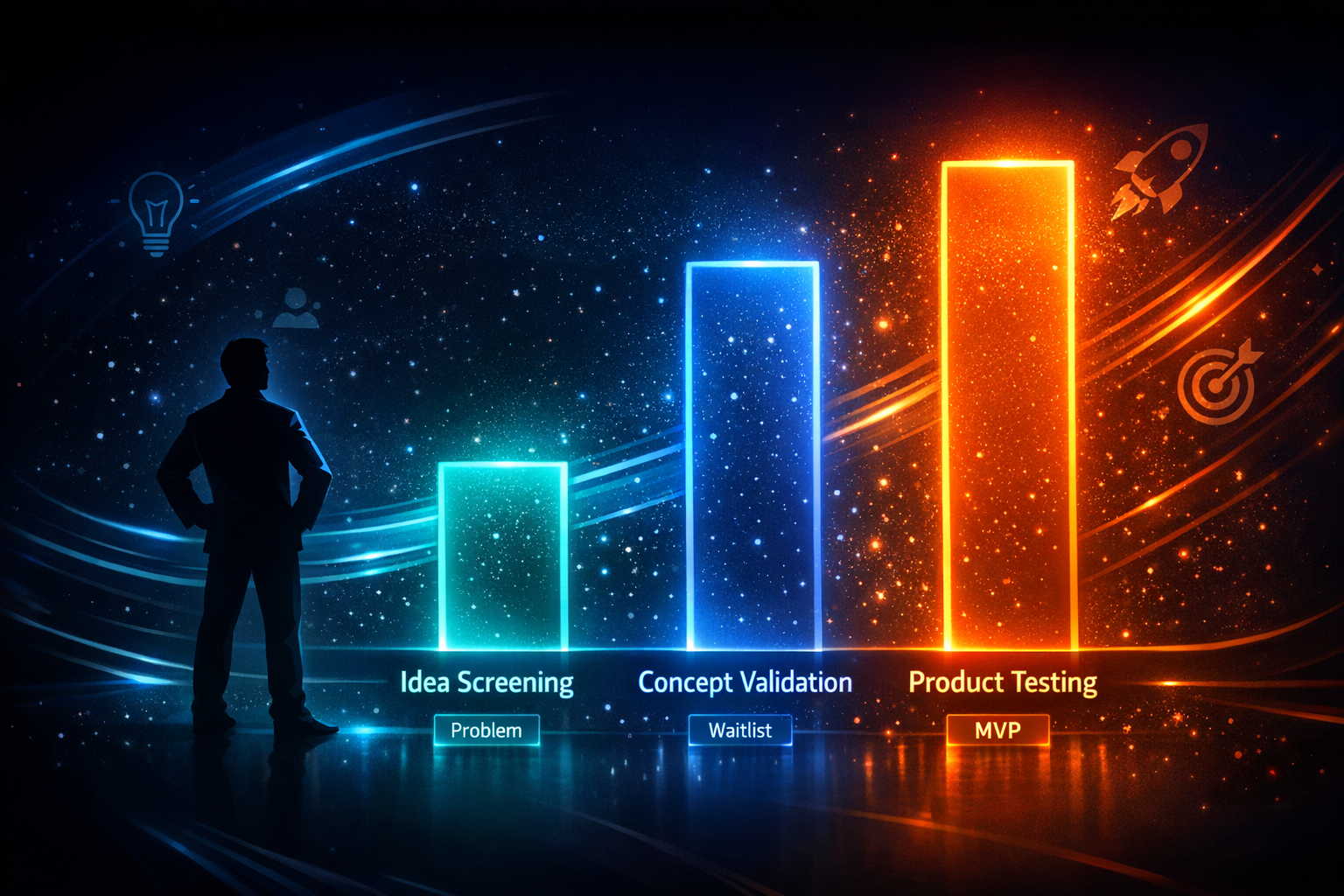
A better approach is to treat idea validation as a staged process. There are three levels of idea validation: idea screening, concept validation, and product testing. Each level answers a different question, uses different methods, and deserves different proof before you move on. When you understand that sequence, you can test the right thing at the right time instead of jumping straight to building and hoping the market will forgive your assumptions.
Table of Contents
- What idea validation really means
- Why the order of validation matters
- Level 1: Idea screening
- Level 2: Concept validation
- Level 3: Product testing
- How to move from one level to the next
- Common mistakes at each stage
- Final takeaway
What idea validation really means
Idea validation is not about proving that your idea is perfect. It is about reducing uncertainty before you make larger commitments of time, money, code, inventory, reputation, or team attention. In other words, validation should help you decide what deserves deeper investment and what still needs more evidence.
That is why validation should not be treated as a single yes-or-no event. You can have real evidence that a problem exists while still lacking proof that people will commit to your solution. You can also have strong interest in a concept while still lacking proof that a working product will be used, retained, and bought under real conditions. Each level has its own question, and confusing those questions is where many founders get into trouble.
| Validation level | Main question | Typical methods | What a strong signal looks like |
|---|---|---|---|
| Idea screening | Does a real problem exist for a real customer group? | Customer interviews, observation, current-workaround analysis, problem mapping | Clear patterns of pain, urgency, and existing workarounds in a specific segment |
| Concept validation | Will people respond to a specific offer strongly enough to commit something? | Waitlists, mock sales, concierge offers, presales, landing pages, pricing conversations | Meaningful sign-ups, replies, pilot interest, deposits, or buying conversations from the right people |
| Product testing | Can a real product create value, usage, and market traction? | MVPs, prototypes, beta programs, pilots, test marketing, limited launches | Repeated usage, successful task completion, retention, paid conversion, and useful market feedback |
The practical takeaway is simple: do not ask a later-stage test to solve an earlier-stage question. An MVP is a poor way to discover whether the problem exists in the first place. A waitlist is also not enough to prove that a real product will succeed in the market. Good founders match the test to the uncertainty they are actually facing.
Why the order of validation matters
The order matters because the cost of being wrong rises as you move forward. At the idea-screening level, you are mostly spending time listening, observing, clarifying, and sharpening the opportunity. At the concept-validation level, you are investing more effort in framing an offer and testing market response. At the product-testing level, you are starting to spend real product energy, distribution energy, and often real money.
When founders skip ahead, they often get misleading feedback. A polished MVP can attract praise even if the target customer is vague. A landing page can generate clicks even if the core problem is not painful enough to drive real adoption. Test marketing can fail not because the product is hopeless, but because the positioning was never properly validated earlier. The sequence matters because each level is supposed to make the next one smarter and cheaper.
This is also why validation should feel like progressive commitment rather than one giant leap. You want to earn the right to go deeper. First, earn the right to test a concept. Then earn the right to test a product. Then earn the right to scale. That mindset protects you from building too early and doubting too late.
Level 1: Idea screening
Idea screening is the first level of validation. At this stage, the main question is: Do the problem and the customer really exist in a meaningful way? You are not trying to prove that your solution is the winner yet. You are trying to understand whether there is a real opportunity worth pursuing at all.
This is the stage where founders should test things like:
- Who exactly has the problem
- How often the problem shows up
- How painful, costly, or frustrating it is
- What people currently do instead
- Why existing alternatives fall short
Useful methods for idea screening usually include customer interviews, direct observation, industry conversations, support-community reading, and mapping the current workaround landscape. The point is to replace guesswork with sharper evidence. If you keep hearing the same pain, from the same kind of person, in the same context, you are learning something valuable. If every conversation points in a different direction, that is also useful because it tells you the idea may still be too broad or too fuzzy.
Strong signals at this level often sound like this: people describe the same pain in their own words, the pain has consequences, and they already spend effort trying to solve it. Weak signals sound more like polite agreement, general curiosity, or abstract statements such as “Yes, I can imagine that being useful.” Screening is not about compliments. It is about evidence that the problem is real enough to deserve the next stage of testing.
You are ready to move from idea screening to concept validation when you can say, with reasonable clarity, who the customer is, what specific problem matters, and why current alternatives are unsatisfying. Until that is clear, building a concept is usually premature.
Level 2: Concept validation
Concept validation is the second level. Here, the question changes from “Is the problem real?” to “Will people respond to a specific solution promise strongly enough to commit something?” At this stage, you are not yet proving that a finished product works. You are testing whether a clear concept creates enough interest, intent, or commitment to justify building further.
This is where tactics like waitlists, presales, and mock sales become powerful. A waitlist can show whether the positioning attracts the right segment. A presale can reveal whether people will exchange money before the full product exists. A mock sales page or fake-door test can show whether the promise is compelling enough to earn clicks, replies, or follow-up conversations. A concierge offer can test the value proposition manually before it is automated.
What matters at this level is not just volume, but quality of response. One hundred random sign-ups with weak intent may be less valuable than ten strong commitments from the exact segment you want to serve. Good concept validation looks like people asking practical questions, joining a pilot, replying with real workflow details, requesting access, or putting down money. The market starts giving something back, even if the product is not complete yet.
What does not count as strong concept validation? Social likes from the wrong audience. Friendly feedback from people who would never buy. Broad encouragement without a next step. Landing-page traffic without segmented intent. These can be useful directional clues, but they are not the same as commitment. Concept validation works best when your offer is specific enough that the customer can actually react to it.
You are ready to move from concept validation to product testing when you have evidence that a defined segment understands the offer, cares enough to engage, and shows willingness to commit time, access, data, meetings, or money. That does not mean the product is proven. It means the concept has earned a deeper test.
Level 3: Product testing
Product testing is the third level of idea validation. Now the question becomes: Can a real product create value under actual usage and market conditions? This is where MVPs, beta programs, pilots, and test marketing make sense. At this level, you are no longer validating a promise alone. You are validating an experience.
Product testing should focus on the core behavior that matters most. Does the user complete the key task? Do they come back? Do they get the intended outcome? Do they recommend it, pay for it, or continue using it after the novelty fades? Are your onboarding, activation, and usage patterns strong enough to suggest that the product creates real value rather than temporary curiosity?
This is also where founders begin to learn whether distribution and messaging hold up outside of a controlled conversation. Test marketing can expose channel problems, price resistance, onboarding friction, and retention issues that a waitlist will never reveal. A pilot can show whether users truly integrate the solution into their workflow. An MVP can expose whether your understanding of the customer survives contact with real behavior.
The biggest mistake at this stage is overbuilding. Product testing does not require a polished, fully featured product. It requires a version that is real enough to test the core job, the core user experience, and the core buying behavior. If the product test is too bloated, you will spend weeks or months learning something that a smaller MVP could have taught you faster.
You are beyond product testing when you start seeing repeatable value creation and a more stable growth path. That usually looks like consistent usage, repeat engagement, clearer conversion patterns, stronger retention, and evidence that the business can move from isolated tests toward a more repeatable system.
How to move from one level to the next
The easiest way to move through these levels is to ask one discipline-building question at the end of each stage: What uncertainty is still most dangerous if I am wrong? Your next test should target that uncertainty directly.
A simple progression looks like this:
- Move from idea screening to concept validation when the customer, problem, and context are clear enough to frame a concrete offer.
- Move from concept validation to product testing when the market response is strong enough that building a lightweight product test feels earned rather than speculative.
- Move from product testing to broader execution when real users consistently get value and the market response is strong enough to justify deeper investment in product, channel, and operations.
It is also normal to move backward. A weak product test may send you back to concept validation. A weak concept response may send you back to idea screening. That is not failure. It is the purpose of validation doing its job before the stakes get even higher.
Common mistakes at each stage
Each validation level has its own trap:
- Idea screening mistake: talking to people too broadly and coming away with vague encouragement instead of segment-specific evidence.
- Concept validation mistake: measuring attention without measuring commitment, then mistaking curiosity for demand.
- Product testing mistake: shipping too much, too slowly, and learning from a bloated product rather than a focused test.
There is also one bigger mistake that spans all three stages: using validation as a ritual instead of a decision tool. Founders sometimes collect interviews, sign-ups, or beta users without defining what outcome would actually change the next decision. Validation becomes far more useful when every test is tied to a real choice: continue, refine, narrow, pivot, pause, or stop.
Final takeaway
The best founders do not treat validation as one giant hurdle before launch. They treat it as a sequence of smarter questions. First, screen the idea to see whether the problem and the customer are real. Then validate the concept to see whether the offer creates commitment. Then test the product to see whether real usage and market behavior support deeper investment.
If you are working through those stages right now, a structured workflow can help you keep the evidence organized instead of letting it dissolve into scattered notes and memory. IDEA Takeoff is a local-first app built for entrepreneurs who want to capture ideas, develop them into clearer opportunities, track validation work, and move stronger ideas into concept, MVP, and launch-stage progress. You can download IDEA Takeoff here and use it to turn validation from a vague intention into a more disciplined process.
