

A nine-year-old negotiates for a later bedtime and offers to “pay back” the minutes by doing tomorrow’s chores first. A twelve-year-old runs a small digital art page and asks classmates what they’d actually use before drawing anything new. A teenager designs a simple tool that helps the school club track dues. None of these kids are “running a company,” yet all of them are practicing entrepreneurship. They are learning to spot needs, test ideas, talk to people, and bounce back when things don’t work.
Early exposure is less about launching businesses and more about building patterns—curiosity, initiative, and comfort with trying, learning, and trying again. Parents shape that exposure in two ways: passively, through what kids observe at home, and actively, by designing small, safe experiences that make practice easy. When those two roles work together, the effects compound for years.
In this article:
- The big idea
- What early exposure means
- Parents’ passive role (what kids absorb)
- Parents’ active role (what you can do)
- Fresh practice ideas (no clichés)
- Real-life examples
- Age & personality fit
- Measure learning, not money
- Common mistakes & fixes
- Quick wrap-up
1. The big idea
Entrepreneurship starts as a way of thinking and acting, not as a logo or a storefront. Children who regularly meet small, real problems—and are allowed to try solutions—learn how to:
- notice opportunities,
- turn ideas into simple trials,
- listen to feedback without taking it personally, and
- adjust quickly.
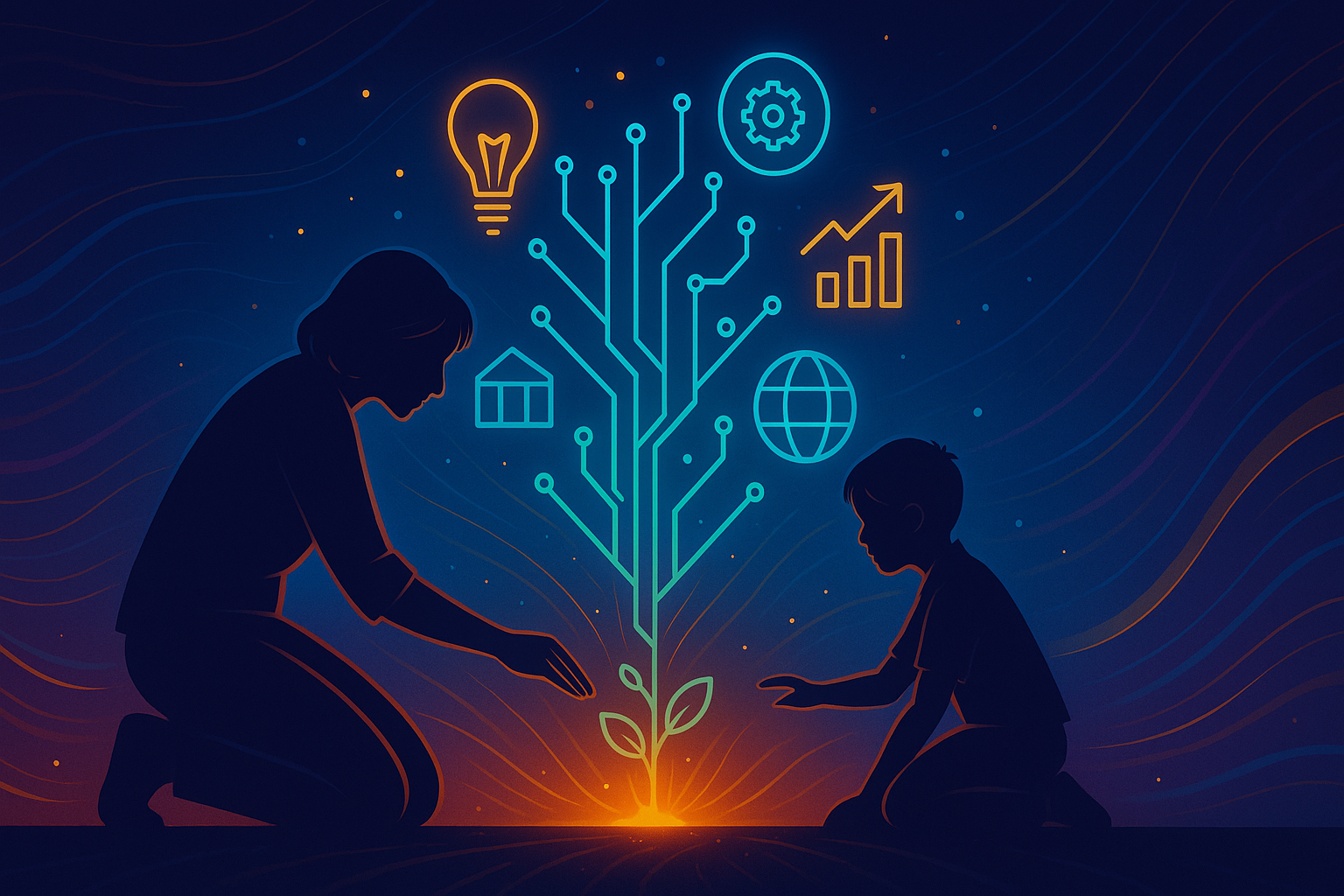
Parents do not need to become managers or investors. The most powerful changes are small: the language used at home, the stories told about work and failure, and the routines that make tiny experiments normal. Think of it as planting and watering—not building a factory.
2. What early exposure means
Early exposure means repeated, age-appropriate chances to practice entrepreneurial behaviors in everyday life. It blends three elements:
- Mindsets: curiosity, initiative, resilience, ethical awareness.
- Methods: framing a problem, sketching a solution, testing with someone real, reflecting on the result.
- Markets: small circles of real users—classmates, neighbors, family friends—who can give honest feedback.
A simple way to remember it:
Exposure = (Environment × Autonomy) + Feedback Loops.
Create a supportive environment, give the child ownership within safe limits, and close the loop with quick, kind feedback.
3. Parents’ passive role (what kids absorb)
Children learn a lot from what they see and hear in the background. This “ambient curriculum” quietly sets the bar for what feels normal.
- Identity modeling. If adults speak with pride about building, serving customers, learning new tools, and solving problems, kids absorb “we make things.”
- Norms around mistakes. Are errors treated as shame or as data? Families that debrief (“What did we try? What did we learn?”) raise kids who keep experimenting.
- Language of money and value. Calm talk about budgeting, trade-offs, and value—without fear or secrecy—teaches that money follows usefulness.
- Time and effort. When children see parents plan their day, protect deep-work time, and follow through, “effort leads to outcomes” becomes obvious.
- Proximity to builders. Meeting adults who design, repair, teach, code, cook, organize, or sell broadens a child’s map of possible futures.
- Stories told at home. Short tales about a failed attempt that later paid off can be more powerful than lectures. They set the tone: progress over perfection.
You don’t have to be an entrepreneur yourself. Being a steady, honest adult who talks through decisions out loud is already a gift.
4. Parents’ active role (what you can do)
Here are practical, low-pressure structures that turn curiosity into practice without turning childhood into a performance.
- Family Entrepreneurial Lab (weekly 60–90 minutes). Pick a small, real problem. Sketch two ways to solve it. Try one. Show it to one person. Reflect. Keep it playful; rotate who chooses the problem.
- Autonomy with guardrails. Parents own safety; kids own decisions. Limit each experiment with a small budget and a timebox, then step back.
- Micro-VC pocket (€10–€50 per experiment). The child pitches: “What is the goal? What will we spend? How will we know if it worked?” Approve the plan, not the outcome.
- Failure budget & debrief. Set an amount of money or materials that can be “lost” each quarter. After each attempt, hold a short debrief: What did we try? What signal did we get? What’s a smaller next step?
- Build-in-private diary (or semi-public for teens). Keep a simple log of assumptions, steps, and lessons. This turns scattered tries into visible progress.
- Decision rights map. Clarify which parts the child fully owns (e.g., research, drafting a message) and which require a parent check (e.g., payments, personal data).
- Customer conversations starter kit. Practice five safe conversations: ask about problems first, then show a draft solution. Listening is the skill, not selling.
- Ethics and safety first. Review platforms together, set privacy rules, and talk about fair use, consent for photos, and kindness in public spaces.
These routines make experimentation a habit rather than a high-stakes event.
5. Fresh practice ideas (no clichés)
We will skip the usual examples and go where kids actually spend time today. Each idea can be done with tiny budgets and clear boundaries.
- Digital micro-shops. Create printable planners, study checklists, or device wallpapers. Get feedback from classmates, then list a few items in a parent-managed shop. The goal is to learn what people prefer, not to “sell big.”
- Game economies and modding. Design a custom map or cosmetic pack, then run short playtests: What was fun? What was confusing? Iterate on that feedback.
- 3D printing and small fabrication. Prototype simple objects—cable clips, pencil organizers, custom keycaps. Take pre-orders from friends to avoid inventory.
- Neighborhood services with a twist. Try a subscription compost pickup, a pet enrichment session (play + enrichment toys), or a library-of-things coordinator for the block. Focus on scheduling and consistency.
- Fix a school friction point. Improve the lost-and-found process, streamline club sign-ups, or build a “study prompts” exchange. Success is a smoother system, not money.
- No-code micro-tools. Build a simple calculator (cost of school trip supplies), a form that routes requests to the right parent volunteer, or a reminder bot for practice schedules.
- Content-as-service. Curate a weekly “science finds for our class” or “eco-news for our street.” Subscribers opt in; the product is clarity and time saved.
- Open-source contributions (teen-friendly). File a documentation fix or a tiny bug report. Learn collaboration, versioning, and helpfulness.
- Maker fairs and pop-ups. Spend two hours collecting feedback from 20 people. The metric is conversations, not revenue.
The thread through all of these is the same: choose a real user, create a small version, ask for feedback, and improve.
6. Real-life examples
Real stories make the ideas stick. These young founders didn’t “get lucky”; they practiced early and often, in different ways.
- Nick D’Aloisio (Summly). As a teenager, he explored coding deeply and built a text-summarizing app that caught major attention. His path shows how focused practice plus a real problem can create outsized opportunities.
- Fraser Doherty (SuperJam). He started refining recipes young and learned packaging, storytelling, and retail basics by talking to real customers at markets. Iteration—not a perfect first product—was the key.
- Zandra Cunningham (Zandra Beauty). From early experiments in skincare, she learned branding and the less glamorous parts—ingredient rules, labeling, and talking with buyers.
- Robert Nay (Bubble Ball). A teen who built an iOS game that topped charts; the lesson is rapid prototyping and distribution—try, test, release, repeat.
- Moziah Bridges (Mo’s Bows). He designed bow ties as a child, learned pricing and presentation, and practiced pitching—proof that taste and story can be learned early.
- Emma Yang (Timeless). She built an app to help families living with Alzheimer’s; the takeaway is mission-driven problem selection and empathy interviews.
Each example maps to skills kids can practice at home: deep diving into a craft, iterating in public, understanding rules, and caring about a real user.
7. Age & personality fit
Not every child wants to “sell.” That’s fine—entrepreneurship has builder, analyst, and storyteller paths too. Match the activity to age and temperament so the first steps feel doable.
- Ages 6–9
Temperaments: curious builder, vivid creative.
Good fits: drawing digital stickers with a parent’s help, organizing a toy-swap with simple sign-ins, testing a better way to label school supplies.
Win condition: one real user says, “This helped.” - Ages 10–12
Temperaments: creative maker, friendly helper, budding analyst.
Good fits: printable planners for classmates, pet enrichment sessions on Saturday mornings, a small no-code tool that reminds the class about due dates.
Win condition: ten feedback notes, two iterations. - Ages 13–15
Temperaments: focused builder, social connector, careful planner.
Good fits: modding a game map and running playtests, 3D printed organizers with pre-orders, fixing a school process with a form or simple database.
Win condition: a working version used by at least five people. - Ages 16+
Temperaments: craft deep-diver, mission-driven advocate, data-minded optimizer.
Good fits: contributing to open-source docs, running a neighborhood micro-service with scheduling, building a niche research digest.
Win condition: a repeat user who gives helpful feedback.
A quick matching trick: ask, “Do you like making, helping, explaining, or organizing?” Start where the energy naturally is.
8. Measure learning, not money
Kids can feel pressure the moment money appears. Keep the scoreboard focused on signals that build skill and confidence.
- User conversations: How many real people did we talk to before building?
- Iterations shipped: How many edits did we make after feedback?
- Time-to-feedback: How quickly did we test with someone?
- Pre-commitments: Did anyone sign up, pre-order, or say “tell me when it’s ready”?
- Usefulness notes: Save messages like “this helped me because…”—they teach what value looks like.
A simple weekly check-in works wonders: one short chart (even on paper), one lesson, one next bet.
9. Common mistakes & fixes
Even with the best intentions, it’s easy to drift. Here are the traps to watch for and gentle ways out.
- Parent takeover.
Trap: adults “optimize” the project, and the child becomes a spectator.
Fix: set decision rights. The child owns choices; the parent owns safety and budget. - Public performance pressure.
Trap: posting updates mainly to impress others.
Fix: keep progress logs private at first. Share when there’s a lesson to teach, not likes to chase. - Unsafe or unsuitable platforms.
Trap: jumping into spaces that collect personal data or have rough communities.
Fix: review platforms together; use parent-managed accounts; practice kindness and privacy rules. - Busywork businesses.
Trap: making things no one uses, just to “have a business.”
Fix: talk to users first, and define success as “this solved a real problem for one person.” - Scope creep.
Trap: turning a two-week try into a six-month saga.
Fix: timebox and budget each experiment; if it grows, start a fresh, clearly defined “season two.” - Comparisons to older kids or adults.
Trap: “They did X by 14, why haven’t you?”
Fix: celebrate craft and kindness over speed. Each child’s path is unique.
10. Quick wrap-up
Early exposure to entrepreneurship is not about minting CEOs. It is about giving children a steady diet of small, meaningful tries: noticing a need, making a first draft, asking someone real, and learning from the reply. Parents shape this in two ways at once—by being the kind of people who talk openly about work, money, and mistakes, and by designing tiny, safe experiments that the child owns.
Choose one routine—a weekly Family Entrepreneurial Lab, a micro-budget for experiments, or a simple debrief ritual—and run it for four weeks. Keep the goals small, the feedback kind, and the story focused on usefulness. That is how seeds become habits, and habits become a way of life.