
Digital technology has changed far more than where businesses sell. It can connect a customer order to inventory, suppliers, delivery and service; turn everyday activity into useful data; and help a small team reach customers around the world. But a website, an online store or an AI tool alone does not tell the whole story. To understand digital business, we need to look at how technology shapes the entire organization—and how that organization creates and delivers value.
Contents
- A practical definition of digital business
- Digital business is a business model question, not an IT question
- Digital business, e-commerce and digital transformation are not the same thing
- From digital presence to digital maturity
- Why the definition matters in the age of AI
- The defining test of a digital business
A practical definition of digital business
A practical contemporary definition can be stated as follows:
A digital business is a business in which digital technologies and data are systematically integrated into the creation, delivery, communication, and capture of value, as well as into the internal and external processes required to operate the organization.
The word systematically is important.
Almost every modern company uses email, computers, accounting software, messaging platforms, or social media. Under an extremely broad interpretation, almost every company could therefore be classified as digital. That definition has become progressively less useful as digital technology has become ubiquitous.
At the other extreme, digital business is sometimes treated as synonymous with e-commerce. Under that interpretation, the defining characteristic is simply conducting commercial transactions through digital networks.
Three perspectives help clarify the idea. One counts almost any use of information and communication technology in business. Another focuses on online buying and selling. A broader view looks at how digital technologies connect the organization’s activities, inside and out.
In this broader view, digital technologies extend across both external and internal business processes. Externally, they can support marketing, sales, payments, customer service and supplier coordination. Internally, they can support collaboration, production, analytics, automation and decision-making.
This leads to an important conclusion:
E-commerce can be part of digital business, but digital business is larger than e-commerce.
An e-commerce system primarily concerns transactions: identifying an offer, ordering, paying, and often arranging delivery through digital channels. Digital business concerns the broader system that makes those transactions—and the rest of the organization—work.
Consider an online furniture retailer. The company may have an excellent online store, digital payments, and paid social-media campaigns. Yet customer orders might still be copied manually into spreadsheets, stock levels checked by telephone, supplier orders sent individually by employees, and delivery schedules managed separately.
That company practices e-commerce, but its underlying organization remains only partially digital.
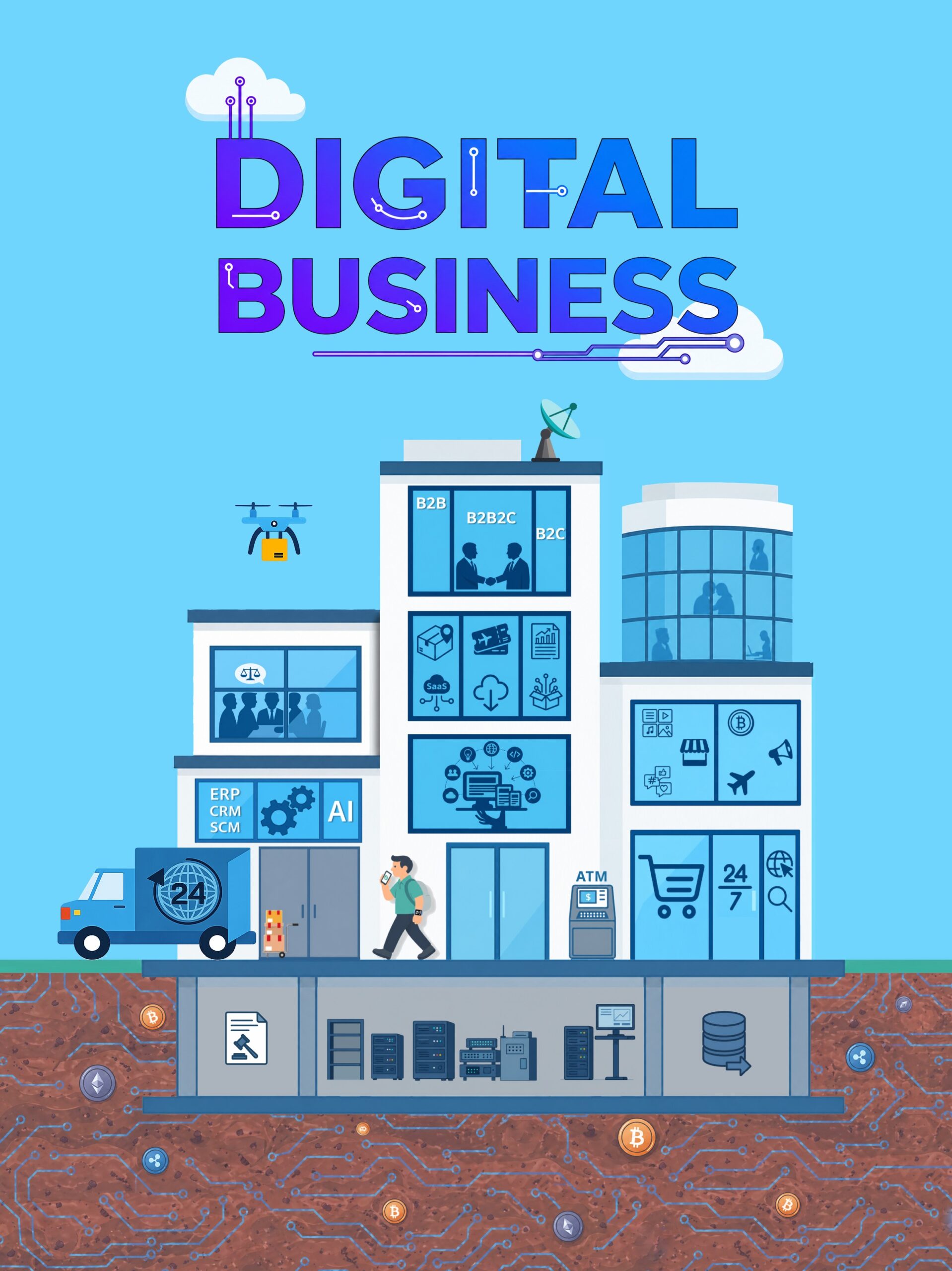
Now consider the same retailer when the web shop communicates directly with inventory management; the CRM records customer interactions; demand forecasts are generated from historical data; stock replenishment is triggered automatically; warehouse activity is digitally coordinated; customers receive real-time delivery information; suppliers exchange information electronically; marketing automation responds to customer behavior; and management dashboards combine sales, margin, acquisition, fulfillment, and retention data.
The website may look almost identical to the customer.
The business behind it is fundamentally different.
That difference captures the essence of digital business.
Digital business is a business model question, not an IT question
The most useful way to understand digital business is through the business model rather than through individual technologies.
A business model explains how an organization creates value, delivers that value to customers, and captures economic value in return. Digital technologies become strategically important when they modify one or more of those mechanisms rather than merely supporting administrative work.
This is why installing software does not automatically constitute digital transformation.
A restaurant using cloud accounting is using digital technology. A restaurant using a digital ordering platform connected with its kitchen, inventory, loyalty program, customer database, delivery partners, payments, demand forecasting, and personalized promotions is changing the logic through which its business operates.
The technology matters because the business model changes.
Digital transformation involves meaningful organizational and strategic change: technology reshapes processes and the way a business creates value.
Cloud computing, artificial intelligence, connected devices, digital platforms and analytics have the greatest business impact when combined with changes in processes, skills and organizational structures.
These capabilities become most useful when they support a coherent business model.
Digital technology enables the value proposition
Some businesses sell inherently digital products: software, streaming media, online education, digital publications, cloud services, data products, or AI applications.
Others sell physical products but use digital capabilities to substantially improve their value proposition. Amazon’s core retail products, for example, are often physical, yet digital technology supports discovery, recommendations, ordering, payment, fulfillment coordination, customer communication, and the surrounding marketplace.
Still other businesses primarily sell human expertise—consulting, design, accounting, education, legal services—but use digital channels and platforms to acquire clients, deliver work, collaborate, communicate, automate administration, and build scalable knowledge assets.
The product therefore does not have to be digital for the business to be digital.
Digital channels connect the business with its market
Digital businesses use channels such as websites, mobile apps, search engines, marketplaces, social networks, messaging systems, email, APIs, and digital advertising to communicate and transact with customers.
The important point is not that every digital business uses every channel. Rather, digital channels become integrated into customer acquisition, service delivery, communication, or revenue generation.
An online business is a narrower idea: a company can digitalize internal operations and partner relationships extensively without earning most of its revenue through a website.
Processes become digitally integrated
This is arguably the decisive feature.
Digital businesses connect previously separate activities through systems and data.
Sales information can feed demand forecasting. Orders can update inventory. Customer behavior can trigger marketing automation. Production data can influence maintenance schedules. CRM information can inform service teams. Financial systems can consolidate transactions automatically. Supplier systems can connect with purchasing processes.
Integration converts isolated digital tools into a digital operating system for the organization.
The goal is to connect customer-facing activities, operations and internal management, rather than digitalizing a single isolated area.
Data becomes an economic resource
Data is another defining characteristic of mature digital businesses.
Transactions, searches, customer interactions, production activity, logistics, sensors, marketing responses, financial processes, and employee workflows generate data that can be captured and analyzed. That information can then support decisions, automation, personalization, forecasting, optimization, experimentation, and new products.
Data can become a valuable business resource when it is organized and turned into useful insights.
This creates a reinforcing loop:
digital processes generate data → data improves decisions and automation → improved decisions enhance processes and customer value → more activity generates more data.
That feedback mechanism is one reason digital businesses can improve more rapidly than organizations whose information remains fragmented across disconnected systems.
Automation increases scalability
Traditional businesses often require proportional increases in labor as transaction volumes increase.
Digital processes can weaken that relationship.
Software can serve additional users at very low marginal cost. Automated checkout can process thousands of transactions. Marketing automation can communicate individually with millions of customers. Digital self-service can resolve routine customer needs. APIs can coordinate transactions between businesses without manual intervention. Generative AI can increasingly assist with content creation, customer support, coding, analysis, and knowledge work.
Automation does not remove people from the business. It changes where human effort creates the most value.
Automation and data-informed decisions can also help smaller firms improve productivity.
Digital businesses operate through networks and ecosystems
Digitalization also changes the boundaries of the firm.
A company can connect with payment processors, logistics companies, advertising platforms, marketplaces, cloud providers, software vendors, freelancers, suppliers, distributors, and customers through digital interfaces.
Consequently, value creation increasingly happens across ecosystems, not entirely within individual firms.
A small online merchant, for example, can combine a SaaS storefront, Stripe or another payment provider, cloud infrastructure, an international delivery network, social-media platforms, advertising networks, CRM software, analytics tools, and external fulfillment.
The merchant owns only part of the infrastructure required to operate the business.
That modularity dramatically expands what small organizations can accomplish.
Digital business, e-commerce and digital transformation are not the same thing
These terms are often used interchangeably, but separating them produces a much clearer conceptual model.
Digitization is the conversion of analog information into digital form. Scanning paper invoices into PDF files is digitization.
Digitalization is the use of digital technology to improve or redesign activities and processes. Replacing paper invoicing with an integrated electronic invoicing workflow is digitalization.
Digital transformation is the broader organizational change that occurs when digital technologies substantially reshape processes, capabilities, customer experiences, business models, structures, or value-creation logic. The academic literature increasingly uses the term in this organizational sense rather than simply as a synonym for installing technology.
E-commerce concerns electronically enabled commercial transactions, particularly buying and selling through digital networks.
Digital business describes the resulting business system when digital technologies become deeply embedded in how the organization creates, delivers, communicates, and captures value.
The concepts therefore overlap, but they answer different questions.
Digitization asks: Is the information digital?
Digitalization asks: Is the process digitally enabled?
E-commerce asks: Can the transaction take place digitally?
Digital transformation asks: How is the organization changing because of digital technology?
Digital business asks: To what extent does the business itself operate through digitally enabled value creation and digitally integrated processes?
Digital maturity involves more than owning a single tool. In 2025, 72% of EU small and medium-sized enterprises reached at least a basic level of digital intensity. The gap remained substantial: 7.3% of small enterprises had very high digital intensity, compared with 42.7% of large enterprises.
The implication is significant.
Digital business is better viewed as a continuum of integration and maturity than as a binary category.
From digital presence to digital maturity
Digital maturity develops over time. Zlatko Bezovski describes a progression from digital communication toward transactions and more comprehensive integration across the business.
Companies rarely jump directly from traditional operations to fully integrated digital businesses. They typically build capabilities over time, moving from communication and individual tools toward connected commercial and operational processes.
In current terminology, this can be interpreted as a four-stage digital maturity pathway.
Digital presence and external communication
At the first level, technology primarily helps the business communicate externally.
Typical capabilities include a website, email, social-media accounts, digital advertising, online listings, and basic customer communication.
The business is visible digitally, but the underlying operating model may remain largely traditional.
Many small businesses remain at this stage for years. A restaurant can have an attractive Instagram account and appear prominently on Google while reservations, purchasing, inventory, scheduling, accounting, and customer relationships remain largely manual.
Digital marketing alone therefore does not make a mature digital business.
Internal digitalization
At the next stage, technology begins to improve internal coordination.
The company may introduce cloud collaboration, accounting systems, digital document management, project management, HR systems, inventory software, shared databases, or other applications.
Efficiency improves, but systems may still operate independently.
This stage creates digital infrastructure without necessarily creating an integrated digital business.
Digital transactions and e-commerce
The third stage connects digital capabilities more directly with revenue generation.
Customers can order, subscribe, reserve, purchase, or pay digitally. Products or services may be delivered through digital channels, or physical delivery may be coordinated electronically.
This is the point at which a company unmistakably participates in e-commerce.
But e-commerce does not guarantee end-to-end integration. A digital storefront built on inefficient traditional processes can expose existing weaknesses. Making the most of digital commerce requires improving the processes behind the transaction.
Integrated digital business
The highest level is reached when technology connects front-office, back-office, and ecosystem processes.
Customer acquisition links to CRM. CRM links to sales and service. Orders connect with inventory and fulfillment. Operations generate management data. Supplier relationships become digitally coordinated. Analytics guide decisions. Automation removes repetitive tasks. Information flows across organizational boundaries.
At this level, digital technology is no longer a department, project, or marketing channel.
It becomes part of the architecture of the business.
Digital maturity is therefore not determined simply by how advanced an organization’s technology appears.
A company can experiment with generative AI while still transferring orders manually between disconnected systems.
Another may use relatively ordinary technologies—ERP, CRM, cloud collaboration, analytics, automated workflows—but integrate them extremely well.
The second company may be considerably more digitally mature.
Cloud computing and connected devices are increasingly widespread, while advanced analytics and AI are adopted unevenly across businesses.
Digital maturity should therefore be evaluated through integration, organizational capability, process redesign, data use, and business impact, not through the novelty of individual technologies.
Why the definition matters in the age of AI
Artificial intelligence makes the distinction between “using technology” and “being a digital business” even more important.
Almost any organization can now open an account with an AI service.
That does not automatically transform its business model.
A company becomes meaningfully more digital when AI becomes connected with real processes: customer service, marketing, knowledge retrieval, forecasting, product development, personalization, coding, operations, decision support, or workflow automation.
The same principle applied to earlier generations of technology.
Having a website was once considered innovative. Then websites became normal.
Having social-media accounts once signaled digital sophistication. Then they became normal.
Cloud software followed a similar path.
AI is beginning to do the same.
The strategic question is therefore not whether a company uses AI, but where AI is integrated into value creation and how it changes performance.
The underlying principle is durable: digital business emerges when technology connects the processes through which an organization operates.
Cloud computing, connected devices, AI, data infrastructure, digital platforms and communication technologies increasingly reinforce one another.
For managers and entrepreneurs, this changes the question from:
What new digital tool should we adopt?
to:
How can digital technology improve the system through which we create, deliver, and capture value?
That is a business question.
And that is ultimately why the term digital business is more useful than a technology-centered definition.
The defining test of a digital business
A company should not be considered genuinely digital merely because it has a website, advertises online, accepts electronic payments, sells through an online store, uses cloud software, or experiments with AI.
Those activities are signals of digitalization.
The stronger test is whether digital technologies and data meaningfully connect the major components of its business model and operations.
A useful diagnostic is to examine six areas: the value proposition, customer relationships and channels, revenue and transactions, operations and internal processes, partner and supply-chain relationships, and data-driven decision-making.
The more these areas depend upon and interact through digital systems, the more strongly the organization can be described as a digital business.
The tools may change, but the central idea remains consistent.
Twenty years ago, the discussion centered on Internet technologies, intranets, extranets, websites, ERP, CRM, and electronic commerce. Today we are more likely to speak about cloud computing, APIs, SaaS, platforms, ecosystems, omnichannel experiences, automation, analytics, AI, connected devices, and data-driven organizations.
The technologies have evolved.
The underlying principle has not.
A digital business is not defined by where it sells. It is defined by how it operates and creates value.
The most digitally mature organizations do not simply place technology on top of traditional business processes. They redesign those processes around digital capabilities, integrate information across organizational boundaries, use data continuously, automate where automation adds value, and connect customers, employees, partners, and systems into a coherent operating model.
That is what separates a business that merely uses digital tools from a business that has become digital by design.
Sources
- Zlatko Bezovski, Electronic Business, Goce Delčev University – Štip, 2026, ISBN 978-608-277-150-2.
- Zlatko Bezovski, E-Business, teaching material, 2016.
- Gregory Vial, “Understanding Digital Transformation: A Review and a Research Agenda”, 2019.
- OECD, OECD Digital Economy Outlook 2024.
- OECD, “The Value of Data in Digital-Based Business Models”.
- OECD, 2024 OECD D4SME Survey.
- Eurostat, Digitalisation in Europe 2026 and Key Figures on European Business 2026.
