
The terms founder and entrepreneur are frequently used interchangeably in business conversations, startup communities, and even professional publications. A person who launches a technology startup is called a founder, an entrepreneur, or sometimes both. But are these terms actually synonymous?
The short answer is no. While founders and entrepreneurs share many characteristics, they represent different dimensions of business creation and development.
A founder is someone who establishes a new business or organization. An entrepreneur, on the other hand, is someone who identifies and pursues business opportunities, mobilizes resources, accepts uncertainty, and seeks to create economic value. Entrepreneurship may involve establishing a new company, but it can also occur through acquiring, transforming, or expanding existing businesses.
This distinction becomes particularly interesting when we examine the different roles and mindsets associated with each.
A founder might be primarily concerned with transforming an original idea into a functioning business. An entrepreneur may focus on identifying attractive market opportunities, developing sustainable business models, and scaling operations. However, these priorities frequently overlap, and the same individual may demonstrate both approaches simultaneously.
Understanding these differences can help aspiring business owners clarify their ambitions, build more balanced teams, and recognize different paths to entrepreneurial success.
Table of Contents
- What Is a Founder?
- What Is an Entrepreneur?
- Founder vs. Entrepreneur: Key Differences
- Primary Focus: Creating an Idea vs. Exploiting Opportunities
- Business Origination: Starting vs. Acquiring and Scaling
- Core Motivation: Passion, Profit, and Value Creation
- Mindset: What Can I Create vs. How Can We Generate Repeatable Value?
- Emotional Attachment vs. Business Objectivity
- Where Founders and Entrepreneurs Overlap
- Can You Be an Entrepreneur Without Being a Founder?
- Are All Founders Entrepreneurs?
- How Founders and Entrepreneurs Can Manage Business Ideas
- Conclusion
What Is a Founder?
A founder is an individual who establishes a new company, organization, or business venture, either independently or together with other people.
The defining characteristic of a founder is the act of founding. The individual participates in bringing a new organizational entity into existence.
A founder typically becomes involved at the earliest stages of a venture, when there may be little more than an idea, a perceived problem, and a willingness to build something new.
This early involvement often requires multiple responsibilities:
- Developing the initial business concept and vision.
- Bringing together a founding team.
- Securing initial financial and operational resources.
- Creating the first product or service.
- Establishing the business structure and operations.
- Attracting the first customers.
Consider someone who develops an application to help students organize their academic activities. This person identifies a problem, designs an initial solution, builds a prototype, and establishes a company to commercialize it.
That individual becomes the founder of the venture.
Importantly, the founder does not necessarily have to invent the original idea personally. Several people may establish a company together, becoming co-founders, even when only one originally proposed the concept.
Being a founder is primarily associated with the origin of a business, not necessarily with a particular management style or personality.
A founder may subsequently become the CEO, retain an ownership stake without participating in management, or even sell the entire company. Regardless of these changes, the historical fact that the individual founded the company remains unchanged.
What Is an Entrepreneur?
An entrepreneur is someone who identifies and pursues business opportunities, organizes resources, manages uncertainty, and creates value through economic activity.
Unlike the term founder, which emphasizes the establishment of a business, entrepreneurship places greater emphasis on initiative, opportunity recognition, resource mobilization, and action.
Entrepreneurs can create new businesses, but they are not limited to this approach.
For example, an entrepreneur might acquire an underperforming restaurant, introduce a new operating model, improve its digital marketing, and transform it into a profitable chain.
Although this person did not establish the original restaurant, the acquisition and transformation demonstrate entrepreneurial activity.
Similarly, an entrepreneur might acquire several complementary companies, combine their operations, and develop a larger business ecosystem.
The Global Entrepreneurship Monitor takes a broad view of entrepreneurship, including new venture creation, self-employment, and the expansion of existing businesses.
Other approaches emphasize identifying and exploiting new products, processes, or markets.
Consequently, entrepreneurship should not be reduced to the formal act of registering a new business. It concerns what individuals do to create and develop economic opportunities.
An important qualification is that simply owning shares or investing passively in an existing company does not necessarily make someone an entrepreneur. Entrepreneurial activity implies some meaningful involvement in identifying, developing, or exploiting an opportunity.
Founder vs. Entrepreneur: Key Differences
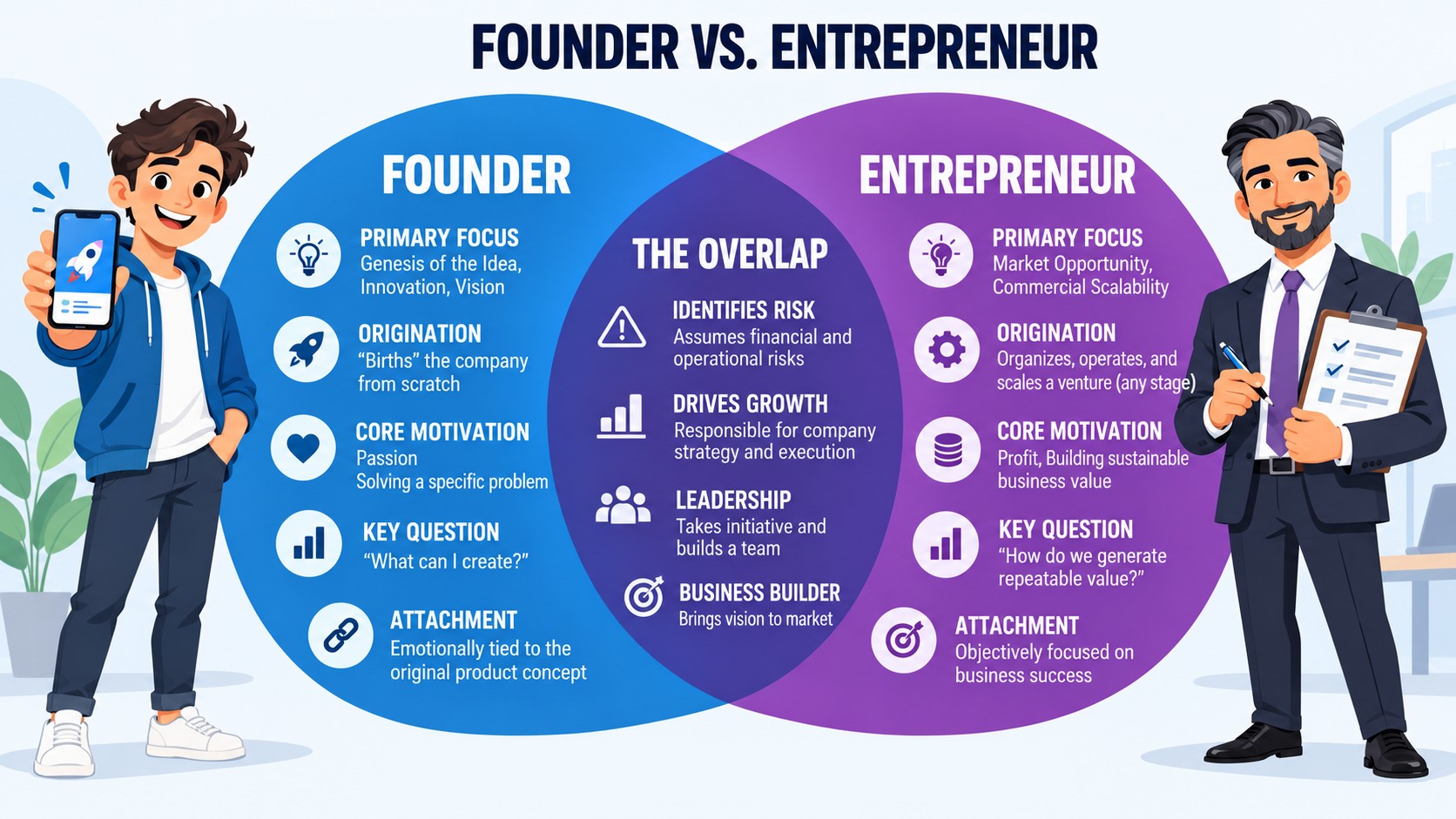
The following comparison summarizes typical distinctions between founders and entrepreneurs.
| Dimension | Founder | Entrepreneur |
|---|---|---|
| Primary focus | Establishing a new business | Identifying and exploiting business opportunities |
| Origination | Creates or co-creates a venture | May found, acquire, transform, or expand a business |
| Core motivation | Often driven by a particular idea, problem, or vision | Often driven by opportunity, value creation, and business development |
| Key question | What can I create? | How can we create and capture repeatable value? |
| Attachment | May feel strongly attached to the original concept | May be more willing to evaluate alternative business opportunities |
| Business stage | Particularly associated with establishment and early development | May operate at any stage of the business lifecycle |
| Risk | Faces uncertainty in establishing a new venture | Faces uncertainty when pursuing entrepreneurial opportunities |
| Growth | Can pursue substantial business growth | Can pursue growth through multiple entrepreneurial strategies |
These differences describe typical orientations rather than fixed personality categories.
A successful founder must also understand customers, profitability, operations, and growth. An entrepreneur who acquires a business may be just as passionate about its products as the person who originally established it.
The most meaningful distinction is therefore the founder’s relationship to the creation of an organization versus the entrepreneur’s relationship to entrepreneurial opportunities and activities.
Primary Focus: Creating an Idea vs. Exploiting Opportunities
One of the most recognizable differences concerns where individuals initially direct their attention.
The founder’s focus: From idea to reality
Founders frequently begin with a particular problem or an idea they want to bring to life.
Their thinking may revolve around questions such as:
Can this idea become a real product? Can I build a company around it? What resources and people do I need to make it happen?
For example, a software developer notices that small retailers struggle with inventory management. After experimenting with several technical solutions, the developer decides to establish a SaaS company offering an affordable inventory management platform.
The immediate challenge is transforming a proposed solution into an operational business.
This process requires creativity, commitment, and considerable persistence. The founder must move from imagining a solution to implementing it under real-world constraints.
The entrepreneur’s focus: Recognizing market opportunities
Entrepreneurs may approach the same market from a different direction.
Instead of beginning with a particular product, they might first identify an underserved customer segment, a market inefficiency, a technological shift, or an emerging pattern of demand.
An entrepreneur examining inventory management might discover that several existing software providers have good products but weak distribution.
Rather than developing another application, the entrepreneur could acquire one of these businesses, improve its marketing and operations, and expand into new markets.
Both individuals may create economic value, but their paths differ.
The founder builds a new organizational vehicle to pursue an opportunity. The entrepreneur can choose among several vehicles for exploiting that opportunity.
Nevertheless, opportunity recognition is essential for many founders, and idea creation is equally important for entrepreneurs. The two activities should not be treated as mutually exclusive.
Business Origination: Starting vs. Acquiring and Scaling
The most objective difference between a founder and an entrepreneur concerns how they become involved with a business.
Founders build from the beginning
Founders establish new ventures.
Depending on the business, this may mean developing a new product, registering a company, designing an initial business model, assembling a team, or building a customer base from nothing.
At this stage, resources are usually limited, processes are incomplete, and the future of the business is uncertain.
The founder must simultaneously address strategic and practical questions: Who are the customers? What should the company offer? How will it generate revenue? Which activities should be performed internally?
Entrepreneurs have additional routes
Entrepreneurs can follow the founding route, but they can also pursue other forms of business development.
One possibility is entrepreneurship through acquisition, where an individual purchases an existing business and actively develops it.
Another is building a portfolio of businesses, identifying complementarities between ventures, and allocating resources toward the most promising opportunities.
A third involves business transformation, where an entrepreneur introduces new technologies, processes, products, or business models into an existing organization.
For example, imagine a traditional printing company with an established customer base.
An entrepreneur acquires the company and expands its offering into personalized online printing, automated ordering, and subscription-based corporate services.
The entrepreneur has not founded the original company. Yet substantial entrepreneurial value may be created through recognizing a new opportunity and reorganizing the business around it.
Entrepreneurship can also involve exiting a successful venture. A business owner might sell one company and use the proceeds, experience, and professional network to start or acquire another.
Such individuals are sometimes called serial entrepreneurs.
This illustrates why entrepreneurship extends beyond business creation: it may include acquisition, growth, transformation, diversification, and exit.
Core Motivation: Passion, Profit, and Value Creation
Motivation provides another useful perspective, although the distinction here is less absolute.
Founders: Passion for a particular vision
Founders are often motivated by the desire to solve a personally meaningful problem or realize a specific vision.
Someone who experiences difficulties accessing healthcare services might develop a digital solution that connects patients with appropriate providers.
The project may begin with personal frustration, professional experience, curiosity, or a commitment to improving an existing process.
This connection can provide the persistence needed to overcome early obstacles.
However, passion alone cannot establish commercial viability. A founder also needs a realistic business model and sufficient demand.
Entrepreneurs: Creating sustainable business value
Entrepreneurs are often associated with the pursuit of profitable market opportunities and sustainable economic value.
Their attention may be directed toward market demand, resource productivity, scalability, and returns on investment.
For instance, an entrepreneur might identify an opportunity to introduce automated self-service facilities in a market where labor costs and customer expectations are changing.
The original motivation may not be emotional attachment to the technology itself, but the recognition of an attractive commercial opportunity.
Still, profit is not the only possible entrepreneurial motivation.
Entrepreneurs may seek independence, social impact, innovation, lifestyle flexibility, or the satisfaction of building successful organizations.
Likewise, founders can be highly profit-oriented from the beginning.
A more accurate interpretation is that founders may initially identify strongly with a specific vision, while entrepreneurs may be especially attentive to the commercial potential of available opportunities.
In successful ventures, purpose and economic sustainability frequently reinforce each other.
Mindset: What Can I Create vs. How Can We Generate Repeatable Value?
The questions people ask often reveal how they approach business challenges.
For a founder, the guiding question may be:
“What can I create?”
This question encourages experimentation, creativity, and the development of new solutions.
It is particularly relevant during the early stages of a startup, when the product, business concept, and operating model are still evolving.
For an entrepreneur, the guiding question may be:
“How can we generate repeatable value?”
This question emphasizes the development of business mechanisms that can consistently create value for customers while generating sufficient revenue to sustain operations.
Consider a founder who builds a mobile application for managing personal finances.
Initially, the central challenge may be delivering useful features, designing an intuitive interface, and attracting the first users.
Over time, the questions change.
How can the application acquire customers economically? Which users are willing to pay? Can customer support be scaled? Is there a sustainable subscription model?
At that point, the founder must increasingly adopt the perspective commonly associated with entrepreneurship.
The business cannot survive indefinitely on product creativity alone.
Similarly, an entrepreneur who acquires an established company may need to become highly creative when existing products fail to meet changing customer expectations.
Creation and scalability are complementary capabilities, not competing identities.
Successful business development requires the ability to imagine new possibilities and establish repeatable processes that turn those possibilities into value.
Emotional Attachment vs. Business Objectivity
One of the most interesting differences concerns people’s relationships with their business ideas.
The founder’s attachment
Founders often invest substantial time and personal effort in developing their original concepts.
Consequently, the venture may become closely connected with their identity, ambitions, and professional achievements.
This attachment can be beneficial.
It may strengthen resilience, sustain motivation during difficult periods, and help founders communicate a compelling vision to employees and investors.
However, excessive attachment also creates risks.
A founder who strongly believes in a product may dismiss negative customer feedback, underestimate competitors, or continue investing in an idea despite insufficient evidence of demand.
This is particularly dangerous when personal conviction is mistaken for market validation.
The entrepreneur’s objective perspective
An entrepreneur managing several opportunities may be more accustomed to comparing projects based on their strategic and economic potential.
Instead of asking whether an original idea must succeed, the entrepreneur may ask whether continuing, modifying, acquiring, or abandoning a particular venture represents the best use of available resources.
This approach can support more disciplined decision-making.
For example, an entrepreneur operating three digital businesses might allocate additional capital to the company demonstrating stronger customer retention and clearer opportunities for growth.
However, experienced entrepreneurs can also become emotionally attached to their investments and strategic decisions.
Therefore, objectivity should be understood as a capability that both founders and entrepreneurs need to develop.
The strongest approach combines conviction about the problem with flexibility about the solution.
A founder should remain committed to creating value without becoming permanently attached to the first version of a product or business model.
Where Founders and Entrepreneurs Overlap
Despite the differences discussed above, founders and entrepreneurs share a substantial set of responsibilities.
In practice, the intersection between the two concepts is often more important than their differences.
Risk-taking and uncertainty
Both founders and entrepreneurs operate under uncertainty.
A founder developing a new company risks investing time, capital, and reputation in an unproven business.
An entrepreneur acquiring an existing company may face significant financial, operational, and competitive risks.
The nature of the uncertainty differs, but neither role eliminates it.
Effective risk management involves identifying assumptions, assessing potential losses, gathering evidence, and adjusting decisions as new information becomes available.
Entrepreneurship should not be confused with reckless risk-taking.
Driving business growth
Founders and entrepreneurs frequently work toward business growth.
Growth may involve increasing revenue, expanding market reach, introducing products, improving profitability, or strengthening operational capabilities.
Although startup founders are often initially focused on establishing the business, successful founders eventually face many of the same strategic challenges as entrepreneurs operating mature organizations.
Growth also does not always mean becoming a large corporation. For some ventures, sustainability, profitability, and independence are more appropriate goals.
Leadership and team building
Both roles require leadership.
A founder may recruit the first developers, marketers, and operational employees.
An entrepreneur acquiring or expanding a company must coordinate existing teams, establish strategic priorities, and manage organizational change.
In both situations, the ability to communicate direction, motivate people, and coordinate activities is essential.
Mobilizing resources
Business ideas cannot succeed without resources.
Both founders and entrepreneurs must identify and obtain financial capital, human expertise, technology, information, and business partnerships.
The founder may be assembling these resources for the first time. The entrepreneur may be reallocating existing resources or combining capabilities across multiple businesses.
The fundamental task remains similar: obtaining and deploying resources to create value.
Building sustainable businesses
Finally, both roles involve transforming opportunities into operational and financially sustainable business activities.
A promising idea is not automatically a viable business. Likewise, acquiring a company does not guarantee entrepreneurial success.
Both must address customer needs, competitive positioning, revenue generation, cost structures, and long-term business performance.
These shared responsibilities explain why so many successful business founders are simultaneously entrepreneurs.
Can You Be an Entrepreneur Without Being a Founder?
Absolutely.
Entrepreneurship does not necessarily require establishing a new company.
Consider three examples.
Example 1: The business acquirer
An individual purchases an established online store and identifies an opportunity to expand into international markets. By improving logistics, marketing, and customer experience, the new owner transforms the company’s growth potential.
The individual is acting entrepreneurially without being the original founder.
Example 2: The corporate innovator
A manager working for a manufacturing company develops a new digital service that helps customers monitor equipment performance remotely.
The innovation creates a new revenue stream for the existing organization.
This is an example of intrapreneurship, or entrepreneurial activity within an established company.
Example 3: The serial business developer
An experienced business owner sells a successful company, acquires another business, reorganizes its operations, and later establishes a third venture.
This individual may simultaneously be a founder of some companies and an entrepreneurial owner of others.
These examples demonstrate that entrepreneurship is better understood as an activity and orientation rather than merely a founding event.
Are All Founders Entrepreneurs?
This question is more complicated than it first appears.
Under broad definitions of entrepreneurship, establishing a new business is itself a form of entrepreneurial activity.
For example, the Global Entrepreneurship Monitor includes attempts at new business creation within its definition of entrepreneurship.
Under this interpretation, someone who establishes a small family restaurant, repair shop, or consulting practice can legitimately be described as an entrepreneur.
However, some approaches emphasize innovation, opportunity exploitation, and the creation or expansion of economic activity beyond routine business operations.
The OECD’s framework for defining entrepreneurial activity places particular emphasis on entrepreneurial actions and value creation.
From this perspective, it is useful to distinguish between establishing a business and demonstrating a strongly entrepreneurial orientation.
Consider someone who establishes a small company to perform a conventional service using an established business model.
The person is clearly a founder. Whether the activity represents entrepreneurship in a narrower, innovation-oriented sense depends on the definition being applied and the actual business behavior.
It would nevertheless be incorrect to assume that small businesses or family businesses are inherently non-entrepreneurial.
A family-owned business can introduce substantial innovations, enter new markets, or develop entirely new business models.
Similarly, a technology startup founder is not automatically a successful entrepreneur merely because the company has been registered.
Founding status tells us how a business began. Entrepreneurial behavior tells us how opportunities are being pursued.
Both dimensions are relevant, but they should not be confused.
How Founders and Entrepreneurs Can Manage Business Ideas
Whether someone intends to establish a startup, acquire an existing company, or expand a business portfolio, the process often begins with recognizing opportunities and developing ideas.
The difficulty is that early business ideas are rarely complete.
They may emerge as observations about customer frustrations, technological trends, inefficient business processes, or unmet market needs.
For founders, the challenge is typically moving from an initial idea toward a coherent business concept.
This involves clarifying the target customers, identifying the problem, developing a value proposition, considering possible revenue models, and testing critical assumptions before committing substantial resources.
Entrepreneurs evaluating existing businesses face related questions.
They may need to compare several market opportunities, identify potential improvements, estimate commercial viability, and prioritize projects based on available resources and strategic objectives.
In both cases, maintaining an organized pipeline of ideas can help separate promising opportunities from attractive but unsupported assumptions.
A dedicated idea management application such as IDEA Takeoff can support parts of this process. It is designed around capturing ideas, developing business concepts, organizing opportunities, and supporting early-stage validation. The linked app-access page provides access to the web application and options for Android users.
For a founder, such a workflow can help document and progressively refine an original startup concept.
For an entrepreneur, it can serve as a structured place to record opportunities, compare potential ventures, and preserve insights that may become valuable in future business decisions.
However, no idea management tool can replace genuine market research, customer interviews, financial analysis, or direct testing.
Tools provide structure. Entrepreneurial judgment determines what should be investigated and which opportunities deserve action.
The objective is not simply to collect more business ideas, but to improve the process of turning promising ideas into informed business decisions.
Conclusion
Founders and entrepreneurs are closely connected, but they are not identical.
A founder establishes a business. An entrepreneur identifies and exploits opportunities to create value, whether through founding, acquiring, transforming, or expanding business activities.
The founder’s role is especially visible during the creation of a new venture, when an idea must be transformed into a functioning organization.
The entrepreneur’s role extends across the broader business lifecycle, from opportunity recognition and startup formation to business acquisition, innovation, growth, and exit.
Their mindsets may also emphasize different questions.
The founder asks, “What can I create?”
The entrepreneur asks, “How can we generate repeatable value?”
Neither question is sufficient on its own.
A company needs creativity to develop valuable solutions, but it also needs commercial discipline to survive and grow. It requires conviction to overcome uncertainty, but sufficient objectivity to recognize when its original assumptions are wrong.
Ultimately, the most capable business builders combine both perspectives.
They can imagine what does not yet exist, recognize opportunities that others overlook, mobilize the necessary resources, and transform promising concepts into sustainable businesses.
You do not necessarily have to be a founder to be an entrepreneur. But becoming an entrepreneurial founder means going beyond starting a company—it means learning how to create, deliver, and sustain real business value.
