
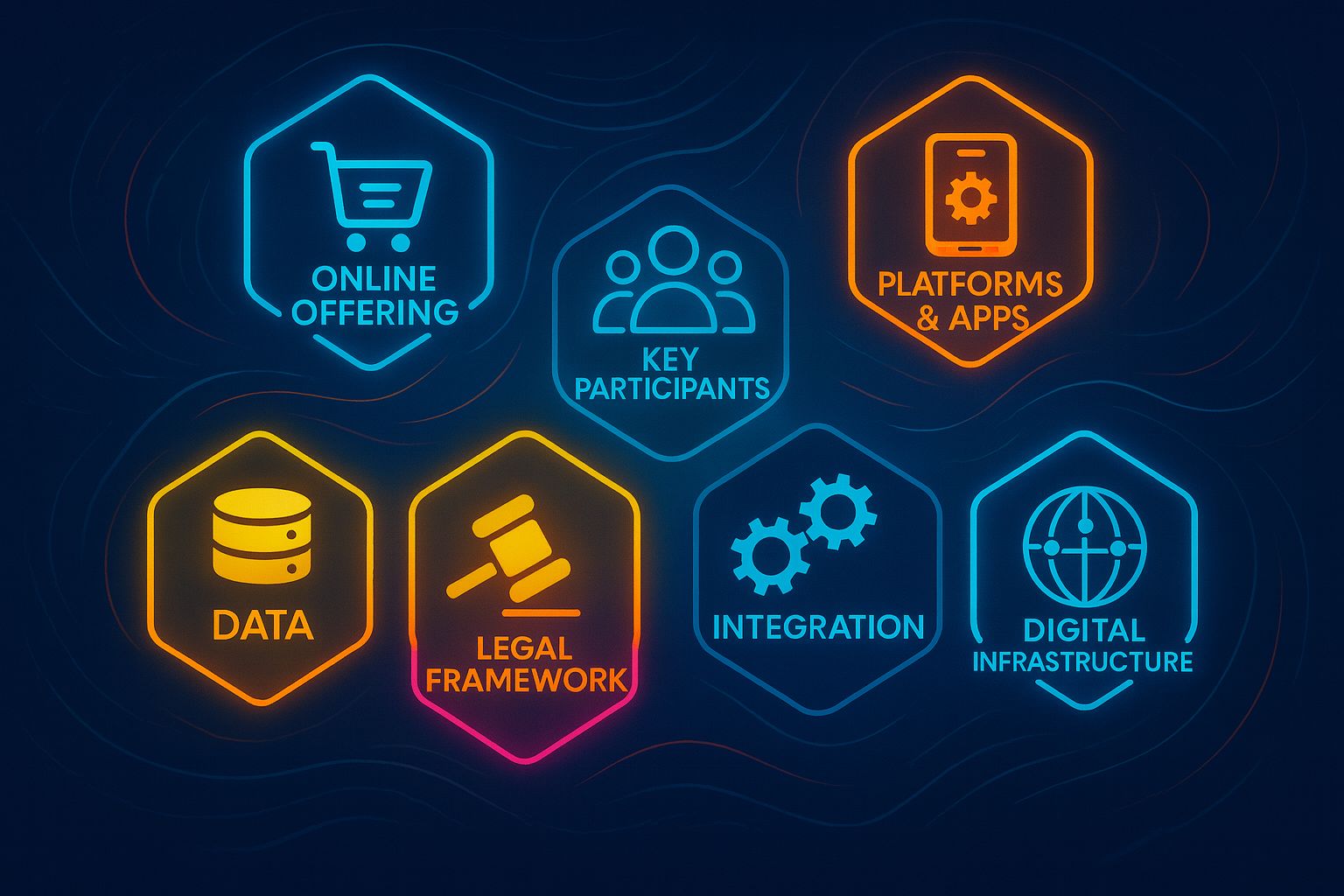
In today’s fast-paced world, digital transformation isn’t just a buzzword—it’s a necessity for any business aiming to thrive. As we step into the new digital era, companies big and small are rethinking how they operate, using technology to streamline processes, reach more customers, and stay competitive. But what does digital transformation really mean? Simply put, it’s the process of using digital tools and strategies to change how a business works, from the inside out. Whether you’re a student studying business trends, a regular user curious about how your favorite apps run, or an aspiring entrepreneur dreaming of launching your own startup, understanding the core components can give you a clear roadmap.
In this article:
- Online Offering: Your Digital Storefront and Services
- Key Participants: The People and Entities Powering Your Digital Journey
- Data: The Fuel for Informed Decisions
- Integration: Connecting the Dots Seamlessly
- Platforms & Apps: The Tools That Make It Happen
- Legal Framework: Navigating Rules and Compliance
- Digital Infrastructure: The Backbone of It All
This article breaks down the seven essential building blocks of digital businesses, inspired by a visual framework that highlights their interconnected nature. These components—Online Offering, Key Participants, Data, Integration, Platforms & Apps, Legal Framework, and Digital Infrastructure—form the foundation of successful digital ventures.
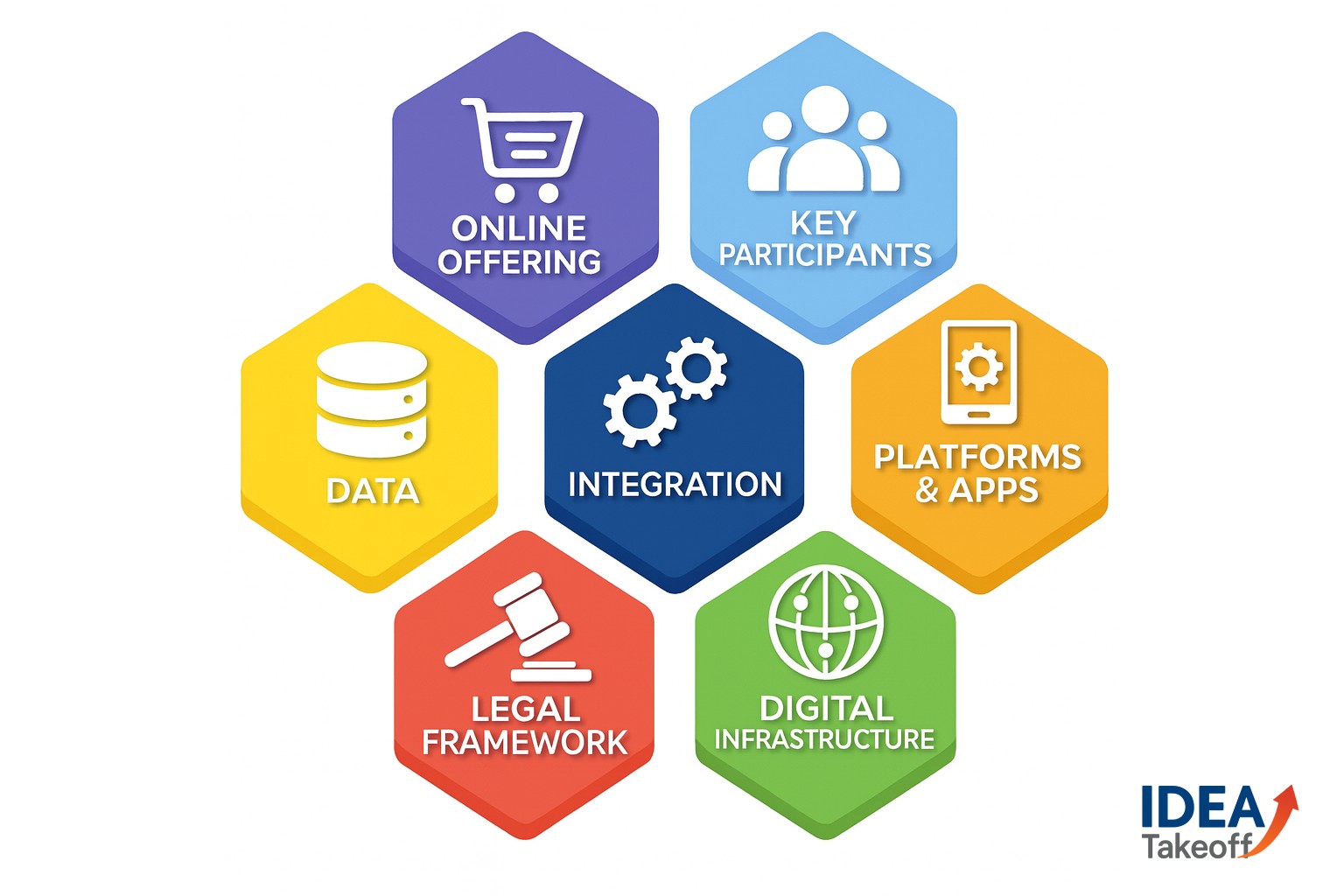
Figure: The Building Blocks of the Digital Businesses
We’ll explore each one in simple terms, with real-world examples, practical tips, and insights to help you navigate this landscape. By the end, you’ll see how these pieces fit together to create resilient, innovative businesses ready for the future.
1. Online Offering: Your Digital Storefront and Services
The first core component is the “Online Offering,” which is essentially what you sell or provide through digital channels. Think of it as your virtual shop window—everything from e-commerce products to subscription services or even free tools that attract users. In a digital business, your offering isn’t limited to physical items; it could be software, content, or experiences delivered online.
Why is this important? In 2025, consumers expect seamless online experiences. According to recent trends, businesses that prioritize user-friendly online offerings see higher customer retention and revenue growth. For instance, if you’re running an e-commerce site, your online offering includes not just the products but also features like personalized recommendations powered by AI.
Real-world examples abound. Take Amazon, which started as an online bookstore but transformed its offering into a vast ecosystem including Prime subscriptions, streaming, and cloud services. This evolution helped them dominate the market by constantly adapting to customer needs. Another success story is Netflix, which shifted from DVD rentals to a streaming service, focusing on original content as its core online offering. This digital pivot turned them into a global entertainment giant.
For aspiring entrepreneurs, start small: Identify a problem your offering solves. If you’re a student, think about apps like Duolingo, which offers language learning online for free with premium upgrades. Tips to get started:
- Research your audience: Use surveys or free tools like Google Forms to understand what they want.
- Keep it simple: Begin with a minimum viable product (MVP)—a basic version of your offering—to test the waters.
- Optimize for mobile: Over 50% of online traffic comes from phones, so ensure your site or app is responsive.
- Incorporate feedback loops: Regularly update based on user reviews to refine your offering.
By nailing your online offering, you set the stage for the other components to shine, creating a compelling reason for customers to engage with your business.
2. Key Participants: The People and Entities Powering Your Digital Journey
No digital business runs on autopilot—the “Key Participants” are the humans behind it all. This includes your team, customers, partners, and even influencers or collaborators. In essence, it’s about building a network of people who contribute to and benefit from your digital ecosystem.
Importance? People are the heart of transformation. A 2025 study emphasizes that successful digital strategies involve empowering employees with skills in AI and data analysis. Without engaged participants, even the best tech falls flat. For students, this means understanding roles like digital marketers or data analysts; for entrepreneurs, it’s about assembling a team that embraces change.
Examples: Airbnb revolutionized travel by involving hosts (key participants) as co-creators of the platform, turning everyday people into business partners. Similarly, Uber’s model relies on drivers and riders as active participants, using ratings and feedback to improve the service. In Albania, women entrepreneurs are leveraging workshops on funding and AI marketing to become key players in digital spaces.
Tips for regular users and aspiring entrepreneurs:
- Foster collaboration: Use tools like Slack or Microsoft Teams to keep your team connected.
- Train your people: Offer online courses on platforms like Coursera for skills in digital tools.
- Engage customers: Build communities on social media to turn users into advocates.
- Partner wisely: Look for alliances with complementary businesses, like a fitness app teaming up with wearable tech companies.
- Prioritize diversity: Diverse teams bring fresh ideas, leading to more innovative solutions.
Remember, key participants aren’t just employees—they’re anyone who interacts with your business digitally, making this component crucial for sustainable growth.
3. Data: The Fuel for Informed Decisions
Data is often called the new oil, and in digital businesses, it’s the third core component. This refers to collecting, analyzing, and using information from user interactions, sales, and operations to drive improvements.
Why it matters: In 2025, data-driven organizations are 23 times more likely to acquire customers. It helps predict trends, personalize experiences, and optimize efficiency. For students, learning data basics can open doors to careers in analytics; entrepreneurs use it to spot opportunities.
Examples: Spotify uses listening data to create personalized playlists, keeping users hooked. Walmart analyzes purchase data to manage inventory in real-time, reducing waste. A Broadridge study shows 86% of firms integrate cloud for better data strategies.
Practical tips:
- Start collecting ethically: Use tools like Google Analytics for website data.
- Analyze with free software: Try Excel or Python libraries for beginners.
- Ensure privacy: Follow GDPR-like rules to build trust.
- Visualize data: Create charts to make insights accessible.
- Act on insights: Don’t just gather data—use it to tweak your offerings.
Data turns guesses into strategies, making it indispensable for any digital business.
4. Integration: Connecting the Dots Seamlessly
Integration is about linking different systems and tools so they work together smoothly—like gluing puzzle pieces. This component ensures your apps, data, and processes communicate without hiccups.
Importance in 2025: With hyperautomation on the rise, integration reduces silos and boosts efficiency. For aspiring entrepreneurs, poor integration can lead to costly errors; students should study APIs as they’re key to modern tech.
Examples: Salesforce integrates CRM with email and analytics for a unified view. Delta Airlines integrated mobile apps with backend systems for real-time flight updates.
Tips:
- Use no-code tools: Platforms like Zapier connect apps without coding.
- Plan for scalability: Choose systems that grow with you.
- Test thoroughly: Simulate scenarios to avoid breakdowns.
- Automate workflows: Link e-commerce to inventory for automatic updates.
- Monitor performance: Use dashboards to spot integration issues early.
Effective integration makes your business agile and responsive.
5. Platforms & Apps: The Tools That Make It Happen
Platforms and apps are the digital workspaces where your business operates—think websites, mobile apps, or cloud platforms like AWS.
Why crucial? They enable accessibility and innovation. By 2025, AI-integrated apps will dominate, enhancing user experiences. Entrepreneurs need user-friendly platforms; students can experiment with app builders.
Examples: Shopify provides an all-in-one platform for e-commerce, helping small businesses go digital. TikTok’s app platform turned short videos into a business empire.
Tips:
- Choose versatile platforms: Start with free ones like WordPress.
- Focus on UX: Make apps intuitive for users.
- Update regularly: Add features based on trends.
- Integrate security: Protect against breaches.
- Leverage app stores: Distribute via Google Play or App Store.
Platforms and apps are your digital playground—choose wisely to play big.
6. Legal Framework: Navigating Rules and Compliance
The legal framework covers regulations, contracts, and compliance in the digital space, like data privacy laws and intellectual property.
Importance: In 2025, with rising cyber threats, strong legal foundations prevent fines and build trust. Entrepreneurs must avoid pitfalls; students learn this in business law classes.
Examples: GDPR compliance helped companies like Apple strengthen user privacy, enhancing reputation. Tesla navigates IP laws for autonomous tech.
Tips:
- Stay informed: Follow updates on sites like FTC.gov.
- Draft clear terms: Use templates for user agreements.
- Consult experts: Hire lawyers for complex issues.
- Implement compliance tools: Software for data audits.
- Educate your team: Train on legal dos and don’ts.
A solid legal framework safeguards your digital empire.
7. Digital Infrastructure: The Backbone of It All
Digital infrastructure includes servers, networks, and cloud setups that support everything else.
Why key? It’s the foundation for scalability. 2025 trends show cloud adoption at 86% for robust infrastructure. Entrepreneurs invest here for reliability; students study it in IT courses.
Examples: Microsoft Azure powers countless businesses with scalable cloud infrastructure. Google’s infrastructure enables fast searches worldwide.
Tips:
- Go cloud-based: Use AWS or Google Cloud for flexibility.
- Ensure redundancy: Backup systems to avoid downtime.
- Optimize costs: Monitor usage to save money.
- Embrace green tech: Choose sustainable providers.
- Scale smartly: Start small and expand as needed.
Strong infrastructure keeps your business running smoothly.
Conclusion
Navigating digital transformation means weaving these seven components into a cohesive strategy. From crafting an appealing online offering to building robust infrastructure, each piece supports the others. In 2025, with AI and automation accelerating change, businesses that master this framework will lead. For students, this is your blueprint for future careers; for entrepreneurs, it’s actionable advice—stay agile, learn continuously, and embrace tech. Start today by assessing your current setup against these components. The digital landscape is evolving—position yourself to thrive in it.
Sources:
[1.]21 Digital Transformation Strategies for Success in 2025 (imd.org)
[2.]Top 10 Key Elements of a Digital Transformation Strategy for 2025 (centricdxb.com)
[3.]Top 10 Essential Components of Digital Transformation – Quixy (quixy.com)
[4.]The Problem With Digital Transformation in 2025 – Canidium (canidium.com)
[5.]How Digital Transformation Is Changing (Again) in 2025 – Nextiva (nextiva.com)
[6.]Digital Transformation in 2025: Strategies, Benefits, & Real-World (splunk.com)
[7.][PDF] 2025 Digital Transformation & Next-Gen Technology Study (broadridge.com)
[8.]The CIO’s Guide to Digital Transformation – Gartner (gartner.com)
[9.]Key Components of Digital Transformation in 2025 (credextechnology.com)
[10.]What is digital transformation? | McKinsey (mckinsey.com)
[11.]10 Digital Transformation Trends for 2025 | Sprinklr (sprinklr.com)
[12.]How To Drive Your Digital Business Transformation – TEKsystems (teksystems.com)
[13.]Digital Transformation Strategy – 9 Key Components | Qentelli (qentelli.com)
[14.]What Is Digital Transformation? How It Works in 2025 – Kissflow (kissflow.com)
[15.]What are the key drivers of digital transformation in 2025? – Quora (quora.com)
[16.]20+ Most Mind-Blowing Examples of Digital Transformation in 2025 (quixy.com)
[17.]19 Examples of Digital Transformation Companies – Yenlo (yenlo.com)
[18.]15 Successful Examples of Digital Business Transformation (revechat.com)
[19.]20 Companies With Successful Digital Transformation in 2025 (dreamix.eu)
[20.]10 Key Components of Digital Transformation Strategy – Structure (wearestructure.com)
[21.]The Essential Components of Digital Transformation (hbr.org)
[22.]Five Components Of Successful Digital Transformations – Forbes (forbes.com)
[23.]The Seven Key Components of a Digital Transformation – Velosio (velosio.com)
[24.]8 Successful Digital Transformation Examples in Business – Terakeet (terakeet.com)
