
- What Traits Mean in the Digital Age
- The Trait Map: Nine Pillars of Modern Entrepreneurship
- Deep Dives into Each Trait
- 30-Day “Trait Upgrade” Plan
- Self-Assessment Framework
- Mini-Cases: Traits in Action
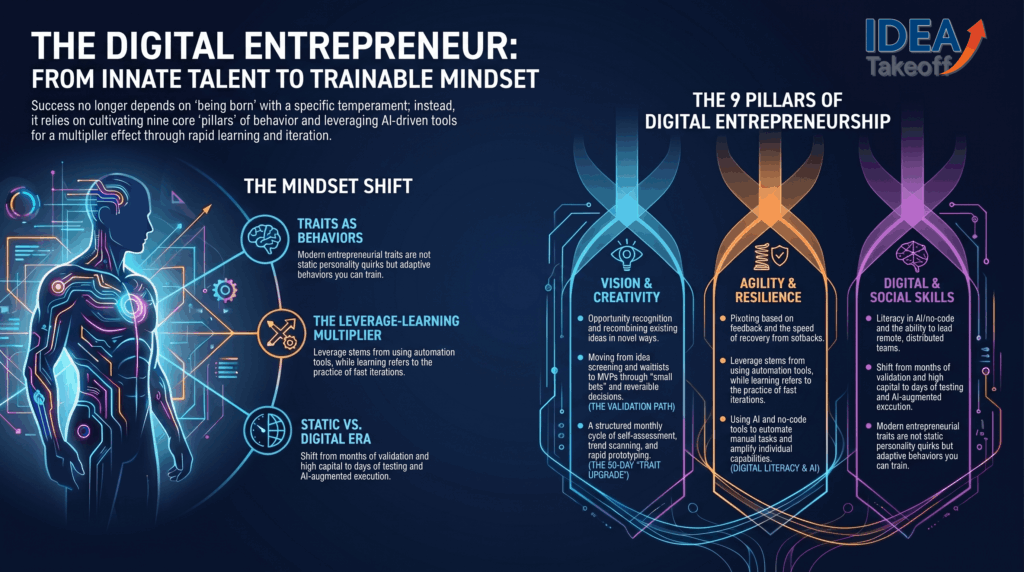
The pace of technological advancement has transformed the landscape for entrepreneurs. In eras past, success often hinged on being born with a certain temperament—an innate ability to take risks, persevere against all odds, or dream up new ideas seemingly out of nowhere. While those attributes remain valuable, the digital age has democratized opportunity and shifted the ground beneath our feet. Today a solo founder armed with a laptop, a Wi‑Fi connection and a handful of cloud‑based tools can build, test and iterate on products in a fraction of the time it took a decade ago. Fast feedback loops, generative AI and global platforms mean that what used to be reserved for large organizations and VC‑backed startups is now accessible to anyone willing to learn. Yet this abundance brings new challenges. Decision fatigue, information overload and psychological burnout threaten to derail progress. That is why modern entrepreneurial traits differ from those romanticized by popular culture. They are not static personality quirks but adaptive behaviors you can nurture and practice. Understanding this distinction is crucial: you don’t have to be born an entrepreneur; you can become one.
At the heart of the digital age lie two interwoven themes: leverage and learning. Leverage stems from using tools—software, automation and networks—to extend your impact far beyond what your personal effort could achieve. Learning refers to the deliberate practice of acquiring, refining and applying knowledge in fast iterations. When these themes intersect, they create a multiplier effect. The right tools will amplify your effort, but only if you wield them with the mindset of constant learning. Many aspirant founders ask, “Do I have what it takes?” A better question is: “Am I willing to commit to developing the traits and capabilities that matter in today’s environment?” By reframing the debate from talent to trainability, we open the door to a wider, more diverse population of entrepreneurs. Throughout this guide we’ll explore each trait in depth, explain why it matters, show how to cultivate it, and highlight tools that support your development. Consider this your handbook for building a resilient, AI‑augmented entrepreneurial mindset.
1. What “traits” mean today
Entrepreneurial traits are no longer simply personality labels. Historically, certain traits were thought to be fixed: you were either creative or not, resilient or not, a risk‑taker or a cautious soul. Those distinctions were reinforced by stories of legendary founders who seemed to single‑handedly will their companies into existence thanks to extraordinary courage or vision. In a slower, more localized economy with limited data, such narratives made sense. Building a business often required large amounts of capital, long planning cycles and significant geographic presence. The personality of the founder took center stage because there were few other variables.
The digital age renders many of those assumptions obsolete. Speed, network effects and continuous improvement have changed the game. Instead of months to validate an idea, we now have days. Instead of needing to own factories or inventory, we can drop‑ship and outsource. And instead of relying on gut instinct alone, we have analytics dashboards, A/B testing and AI assistants that provide real‑time feedback. In such an environment, the static trait model breaks down. Traits become behaviors—things you do repeatedly until they become part of your identity. The ability to handle uncertainty, for instance, is less a predetermined personality marker and more a function of how many small experiments you run, how you interpret failure and whether you can adapt.
This is good news. If you think of traits as behaviors, you can train them like muscles. The process is similar to learning any other skill: identify the desired outcome, break it down into subskills, create practice routines and track progress. Modern founders are more akin to athletes than artists. They adopt frameworks like effectuation, design thinking and the lean startup to guide their actions. They embrace a portfolio approach to ideas, running multiple small experiments rather than betting everything on a single grand vision. They measure success not just by revenue but by cycle time—how quickly you move from insight to implementation—and optionality—the number of viable paths available to you. They know that sustained motivation requires purpose as well as structure: without clear objectives, even the most passionate entrepreneur will drift.
Recognizing that traits are trainable also allows you to leverage technology more effectively. When you’re aware that your natural risk tolerance might be low, you can mitigate that with decision trees and expected value calculations built in a spreadsheet. When you recognize that resilience wanes after repeated setbacks, you can implement reflective practices and recovery rituals. In the past, such interventions were available only to those who could hire mentors or therapists. Today dozens of apps and communities provide support at low or no cost. By combining self‑awareness, deliberate practice and the appropriate tools, you can systematically build each trait. The digital age doesn’t just demand new skills; it provides the infrastructure to acquire them.
2. The trait map
Before diving into the specifics, let’s outline the core traits that serve as the foundation for modern entrepreneurial success. Think of these as pillars of a framework. Each pillar may overlap with others, and within each pillar there are subskills and behaviors. We begin with vision, because without a clear sense of direction, the rest are meaningless. Then we move into creativity, adaptability and resilience—the day‑to‑day capacities that enable you to navigate complexity. Passion and motivation fuel your energy, while calculated risk‑taking ensures you pursue opportunities with prudence. Digital literacy addresses the imperative to understand modern tools, and leadership and collaboration ensure you can align and inspire others. Finally, continuous learning and early exposure to entrepreneurship formalize the need to keep upgrading your mental models.
Here’s an overview of the nine traits we’ll explore:
- Vision & Opportunity Recognition – The ability to perceive emerging patterns, see where markets and technologies are headed and articulate a compelling direction. Vision is not about predicting the future with certainty but about holding a strong hypothesis and iterating on it.
- Creativity & Innovation – The capacity to generate novel ideas, synthesize disparate concepts and produce unique solutions. In the digital age, creativity often involves recombination, such as taking a concept from one domain and applying it in another.
- Adaptability & Agility – The willingness and skill to pivot based on feedback, abandon or revise cherished hypotheses and test alternatives quickly. This trait underlies the lean startup methodology.
- Resilience & Self‑Efficacy – A belief in your ability to execute tasks and a willingness to persist through obstacles. Resilience is about recovery speed; self‑efficacy is about confidence built through evidence.
- Passion & Motivation (Goal Orientation) – Sustained interest in the problem you’re solving combined with structured goal management. Passion without goals leads to burnout; goals without passion leads to apathy.
- Calculated Risk‑Taking – The art of making decisions under uncertainty. Unlike reckless risk‑taking, calculated risk involves structuring bets, estimating upside and downside and limiting exposure.
- Digital Literacy (AI & No‑Code) – An understanding of digital tools, automation, data and how they can be integrated to create value. This trait includes learning to wield AI models, understanding APIs and building with no‑code.
- Leadership & Collaboration – The skill of leading yourself and others. It involves clear communication, ability to align stakeholders and the humility to receive and incorporate feedback.
- Continuous Learning & Early Entrepreneurship Education – A commitment to growth and knowledge expansion. Includes building cognitive frameworks early to accelerate learning and adopting a beginner’s mindset across domains.
These traits are neither exhaustive nor mutually exclusive. They serve as a blueprint you can refine to suit your context. As you read on, remember that your unique combination of strengths and weaknesses will shape how you approach each pillar.
3. Deep Dives into Each Trait:
Vision & Opportunity Recognition
Vision is often romanticized as an epiphany—a lightning strike moment when a founder sees a problem so clearly that solutions flow effortlessly. While epiphanies do occur, they tend to follow prolonged periods of immersion. Vision is a practice, not a personality trait. It begins with cultivating curiosity and awareness about trends, technologies and human behavior. A visionary founder is not clairvoyant but a synthesizer of information who can see around corners because they constantly scan for patterns.
Why it matters now: In the past, industries moved slowly. Once‑in‑a‑generation technological shifts such as the adoption of electricity or the telephone created opportunities that lasted decades. Entrepreneurs had time to experiment, fail, pivot and still catch the wave. Today waves come and go in a matter of years, sometimes months. The smartphone revolution gave rise to mobile apps, but within a decade the platforms matured and user acquisition costs spiked. Social media networks rise and fall. AI advances at breakneck speed. If you wait for perfect clarity, you will always be reacting to someone else’s vision. Opportunity recognition must become a proactive habit. Instead of asking “What should I build?” ask “What patterns am I observing that hint at emerging needs?”
How to train it: Start by improving the quality of your inputs. Feed your brain with sources that broaden your horizons. Subscribe to newsletters across industries, not just your own. Follow thought leaders who share insights about societal shifts, technology and culture. Join communities that encourage knowledge sharing, such as Indie Hackers, Product Hunt or niche Discord servers. Schedule regular “pattern analysis” sessions where you compare notes from different domains. For example, if you notice an uptick in remote work, rising interest in mental health apps and improvements in natural language processing, what new problems might arise at their intersection? This cross‑domain synthesis yields unique insights. Conduct customer interviews and ask open‑ended questions to uncover pain points and latent desires. Document your conversations and look for recurring themes. Your first vision is a hypothesis—test it with low‑fidelity prototypes and landing pages. Keep a vision log to capture each hypothesis, validation effort and lesson learned.
Tools: Google Trends and Exploding Topics highlight spikes in search queries, indicating rising interest in particular subjects. Feedly aggregates blogs and newsletters so you can track multiple industries in one place. Product Hunt surfaces new products daily, providing a snapshot of what builders are creating. AI tools like ChatGPT synthesize information; you can paste notes from interviews and ask the AI to identify common themes or generate insights. Notion or Obsidian are excellent for maintaining a “second brain” where you store ideas, articles and connections. Miro or Whimsical help visualize these connections, making it easier to see how disparate concepts relate.
Micro‑exercises:
- 10–10–1: Collect ten interesting trends from different sources, identify ten unique problems emerging from those trends, then pick one problem to explore deeply each week.
- The Five Whys: When talking to customers, ask “Why?” up to five times to uncover root causes and avoid surface‑level assumptions.
- Reverse‑engineer: Study a successful startup and map out the sequence of insights that led to their product. Try to identify the moment they realized what would differentiate them.
- Opportunity journal: At the end of each day, write down any pain points you observed, interesting tools you discovered or patterns you noticed. Even if it feels trivial, record it. Over months this log becomes invaluable.
Metrics: Track the number of opportunities you identify and validate each month. Measure how many insights turn into experiments. Evaluate your ratio of ideas to tests; a healthy balance might be five ideas explored for every test run. Keep an eye on how many experiments lead to actionable learnings or revenue. Over time, pattern recognition should yield more promising opportunities with fewer false positives.
Creativity & Innovation
Creativity is sometimes mistaken for artistry. In business it manifests as problem‑solving: you see constraints not as blocks but as invitations to think differently. To innovate in the digital age, you need not only new ideas but also the ability to recombine existing ones in novel ways. Modern creativity thrives on diversity of input, openness to experimentation and a willingness to fail. Many entrepreneurs feel pressure to have a singular “big idea,” but most innovations are incremental. Uber didn’t invent taxis; it reimagined dispatch and payment. Airbnb didn’t invent lodging; it reconfigured unused rooms into a marketplace. These successes are built on the practice of connecting unrelated dots.
Why it matters now: The sheer availability of information means that anyone can come up with an idea. The differentiating factor is execution and uniqueness. Generative AI can now create text, images and code; no‑code platforms allow almost anyone to build an app or website. With such democratization, the challenge shifts from access to imagination. If everyone uses the same tools in the same way, products converge to sameness. Creativity becomes a competitive advantage when you find unexpected applications or bring fresh perspectives from other fields. In a world where replication is cheap, originality commands a premium.
How to train it: Creativity flourishes in environments that balance structure and freedom. Constraints often spur creativity by forcing you to search for less obvious paths. The SCAMPER technique (Substitute, Combine, Adapt, Modify, Put to other uses, Eliminate, Reverse) offers a structured way to iterate on an idea. Suppose you run a subscription newsletter: what happens if you substitute the medium (audio instead of text)? Can you combine your newsletter with a community forum? Could you adapt your content to a different audience, such as corporate teams? Could you modify the length, frequency or pricing model? By systematically manipulating components you generate dozens of variants. Diversify your consumption. Read beyond business. Study art, science fiction, biology and psychology. Practice brainwriting, where you write down ideas individually before sharing them with others. This reduces groupthink and ensures introverted thinkers contribute. When you collaborate, look for heterogeneity: people with different backgrounds challenge your assumptions and bring fresh insights.
Tools: Mind mapping software like Miro or Whimsical helps structure thoughts visually. AI art generators such as Midjourney allow you to visualize concepts quickly, which is particularly helpful for branding or product design. GPT‑powered ideation tools can generate prompts, analogies and even potential business models. Notion’s database feature is useful for storing creative stimuli; you can create a table of interesting products, marketing campaigns or user interfaces and cross‑reference them. If you’re experimenting with physical products, rapid prototyping tools such as 3D printers or online fabrication services (e.g. Ponoko) can turn ideas into tangible prototypes fast.
Micro‑exercises:
- 20×20 idea sprint: Set a timer for 20 minutes and brainstorm at least 20 ideas related to a problem. The goal is quantity, not quality; evaluate later.
- Constraint challenge: Pick an everyday object (e.g. a chair). List five completely different versions of it (a chair made of cardboard, a chair built for astronauts, a chair that transforms into a bed, etc.). This trains lateral thinking.
- Remix challenge: Select two unrelated products or concepts and imagine a mashup. What would a “Spotify for mindfulness journals” look like? Or a “Uber for library books”?
- Perspective swap: Describe a feature from the point of view of a future user, a competitor and an investor. Each perspective reveals different priorities.
Metrics: Track your idea pipeline. How many ideas do you generate each week? How many move beyond brainstorming into prototypes or experiments? Use a simple funnel to measure conversion from ideas to experiments to validated concepts. Record the diversity of ideas across categories to ensure you’re not stuck in one domain. Over time, evaluate the outcomes of creative experiments: Did they lead to revenue, engagement or learning? If not, adjust your brainstorming techniques.
Adaptability & Agility
Adaptability is the willingness and skill to pivot based on feedback, abandon or revise cherished hypotheses and test alternatives quickly. Agility is its operational counterpart: the discipline of running tight build–measure–learn cycles so you iterate rather than stagnate. These traits are essential in environments where assumptions are frequently invalidated.
Why it matters now: Historically, entrepreneurs could stick with a single plan for years. Today, markets change faster than business plans. A competitor can clone your feature overnight; a platform update can cut off your distribution channel. Adaptability enables you to respond without panic. It protects you from the sunk cost fallacy and keeps you oriented toward the problem rather than your pet solution.
How to train it: Embrace small bets. Instead of building a fully featured product, launch a minimum viable experiment that tests one assumption. Use frameworks like the lean startup to plan hypotheses, define success metrics and gather feedback. Document decisions and pivots in a decision log. Conduct regular retrospectives: after each sprint, ask what went well, what didn’t and what you’ll try next. Practice detachment by intentionally killing projects you’ve invested in if data shows they’re not working. The more you practice ending ideas gracefully, the easier it becomes.
Tools: Trello, Asana or Jira can manage experiments and track their outcomes. Notion or a simple spreadsheet works for decision logs. Zapier or Make automate repetitive tasks so you can focus on experiments rather than admin. Analytics tools like Google Analytics, PostHog or Mixpanel help measure the impact of changes. Kanban boards visualize work in progress and help you avoid overcommitting.
Micro‑exercises:
- Weekly iteration: Ship something—anything—every week. It could be a prototype, a blog post, a new onboarding flow or a small feature. The goal is to build the habit of shipping.
- Pivot practice: Take one of your product ideas and brainstorm five radically different ways to solve the same problem. Discuss which signals would make you switch paths.
- Retrospective ritual: At the end of each week, spend 30 minutes documenting what you learned, what surprised you and what you’ll adjust. Share it with a peer for accountability.
- Constraint sprints: Force yourself to build a feature in a weekend using only no‑code tools. The constraint will reveal creative shortcuts and challenge perfectionism.
Metrics: Measure your iteration cycle time (the average time from starting an experiment to analyzing its results). Track the number of experiments you conclude each month. Monitor how quickly you act on feedback (time between receiving a signal and implementing a change). Evaluate your percentage of reversible bets: How often are you making small, safe experiments versus big, risky ones?
Resilience & Self‑Efficacy
Resilience is the capacity to recover from setbacks. Self‑efficacy is the belief that you can achieve your goals. Together they underpin persistence. Without resilience you burn out; without self‑efficacy you never start.
Why it matters now: The digital era accelerates both success and failure. You may achieve traction quickly—only to see it evaporate when the algorithm changes. The psychological whiplash can be brutal. Founders must endure rejection, negative comments, competitor copycats and unexpected crises. Resilience keeps you moving forward. Self‑efficacy protects you from self‑doubt and external noise.
How to train it: Build resilience through reflective practices. Maintain an evidence log—a record of your achievements, compliments from users, milestones reached. Revisit it when doubt creeps in. Adopt pre‑mortems and post‑mortems: imagine what could go wrong and how you’d respond; after setbacks, analyze them without shame. Incorporate recovery rituals—sleep, exercise, journaling, meditation—to replenish your energy. Strengthen self‑efficacy by setting micro‑goals that you can achieve quickly. Each small win reinforces the belief that you can accomplish bigger things.
Tools: Journaling apps like Day One or Stoic help capture reflections. Habit trackers like Loop or Streaks gamify routines. Meditation apps such as Calm or Headspace support recovery rituals. Tools like I Done This or a simple Google Doc can serve as evidence logs. You can also use Notion to structure your achievements and reflections.
Micro‑exercises:
- Wins log: Every day write down three things you accomplished or are grateful for. Include small wins like fixing a bug or receiving positive feedback.
- Pre‑mortem: Before launching a new feature or experiment, brainstorm all the ways it might fail and what you’ll do if each happens. This reduces anxiety and clarifies contingencies.
- Reframe failure: After a setback, write a narrative that focuses on what you learned rather than what you lost. Share it with a friend or online community to normalize failure.
- Recovery intervals: Schedule at least one non‑work activity per day (walk, workout, social call) and treat it as non‑negotiable.
Metrics: Track your time to recover: how long does it take you to bounce back from a setback? Monitor your adherence to recovery rituals (e.g. number of workouts per week, meditation sessions). Measure the consistency of your evidence log entries. Periodically assess your confidence levels using a 1‑5 scale before and after major projects.
Passion & Motivation (Goal Orientation)
Passion provides the energy to stick with a problem; goal orientation channels that energy toward measurable outcomes. Many founders have vision and passion but lack structure; conversely, some have goals but lack emotional commitment. You need both.
Why it matters now: Without intrinsic motivation, the lure of quick wins and vanity metrics can lead you to chase fads. Without goals, passion turns into overwork and burnout. Clear objectives and meaningful motivation keep your efforts aligned with your mission.
How to train it: Clarify why you care about the problem you’re solving. Write a personal mission statement and revisit it when motivation dips. Use frameworks like Objectives and Key Results (OKRs) or SMART goals to create structure. Limit your work‑in‑progress to avoid dilution of focus. Design reward mechanisms to celebrate milestones—a treat, a day off, a personal gift. Build a support network (friends, mentors, mastermind groups) to help you stay accountable.
Tools: Notion or Google Sheets can host your OKRs. Apps like Todoist or Things manage tasks aligned to goals. Pomodoro timers (e.g. Focus To‑Do) facilitate deep work sessions. Reflection tools like Walling or Bullet Journal help track progress toward goals. Social platforms like Twitter or Slack communities provide public accountability.
Micro‑exercises:
- Mission canvas: Draft a one‑page manifesto summarizing your purpose, values and the change you want to see. Post it somewhere visible.
- Weekly OKR review: On Friday, review your objectives and key results. Rate your progress and identify obstacles.
- 90‑minute blocks: Schedule two 90‑minute deep‑work sessions daily. After each, record what you achieved.
- Reward triggers: Before starting a difficult task, plan a small reward for completion (e.g. a 15‑minute walk or coffee). This trains your brain to associate effort with positive reinforcement.
Metrics: Monitor objective completion rates. Track deep‑work hours per week. Observe changes in motivation levels by journaling at the start and end of each week. Record the frequency of your reward triggers and correlate them with productivity.
Calculated Risk‑Taking
Calculated risk‑taking is the art of making decisions under uncertainty. Unlike reckless risk‑taking, calculated risk involves structuring bets, estimating upside and downside and limiting exposure.
Why it matters now: When the cost of experimenting is low, the cost of inaction is high. Sticking with a safe job or a single product can seem prudent but may lead to missed opportunities. Conversely, betting everything on an untested idea can be catastrophic. Entrepreneurs must find a middle ground where they take risks that are reversible and proportional to the potential upside.
How to train it: Begin by distinguishing between reversible and irreversible decisions. Jeff Bezos calls these Type 2 and Type 1 decisions. Make reversible decisions quickly; deliberate longer on irreversible ones. Use decision trees and expected value calculations to evaluate options. Design small bets that test key assumptions with minimal resources. Learn to de‑risk by sequencing: tackle the highest‑uncertainty variable first. Build a culture of safe failure—frame experiments as learning costs rather than personal failures.
Tools: Google Sheets or Excel for expected value calculators. Whimsical or Figma for decision trees and scenario mapping. Tools like LaunchDarkly or Feature Flags let you roll out features gradually and reverse them quickly. Profitwell’s Pricing Calculator helps evaluate pricing experiments. Analytics tools aid in quantifying outcomes.
Micro‑exercises:
- Risk inventory: List all the assumptions behind your idea. For each, estimate upside, downside and likelihood. Identify which are reversible.
- Small bet design: Convert a big idea into a series of small bets. For example, before building a full app, launch a landing page with a pre‑order button.
- EV drill: Take a decision you’re currently facing (e.g. which marketing channel to invest in). Calculate expected value for each option: probability of success multiplied by estimated payoff minus cost.
- Reversal ritual: After every major change, evaluate what signals would cause you to revert. Write them down in advance to avoid escalation of commitment.
Metrics: Track the percentage of decisions made with a documented expected value or risk assessment. Monitor the ratio of reversible to irreversible decisions. Review the outcomes of small bets: How many succeeded? How many provided useful learning? Correlate decision quality with outcomes to calibrate your intuition.
Digital Literacy (AI & No‑Code)
Digital literacy goes beyond basic computer skills. It’s about understanding how modern tools—APIs, automation, AI models, no‑code platforms—can amplify your capabilities. It’s also about knowing your limits and when to bring in specialists.
Why it matters now: The founder who harnesses technology outcompetes those who rely solely on manual effort. AI can draft marketing copy, analyze data and generate designs. No‑code platforms can build apps without a software engineering degree. Automation can handle repetitive tasks, freeing you to focus on strategic work. However, misusing tools can create technical debt or privacy risks. A literate founder knows enough to leverage opportunities and avoid pitfalls.
How to train it: Start by mapping your workflow and identifying steps that could be automated. Learn one no‑code platform (e.g. Webflow, Bubble, Glide) and build a small tool relevant to your business. Experiment with AI models like ChatGPT for ideation, summarization and coding assistance. Study basic data literacy: spreadsheets, databases and APIs. Explore automation tools like Zapier or Make to connect apps. Gradually integrate advanced concepts like webhooks, triggers and AI APIs. Balance depth and breadth; you need not master everything but should be aware of possibilities.
Tools: Webflow or Bubble for building websites and apps. Airtable as a flexible database. Zapier and Make for automation. Notion or Coda for integrated docs and dashboards. OpenAI’s API for AI‑driven tasks. Online learning platforms like Coursera or Udemy for structured learning. Communities like Makerpad or No Code Founders for inspiration and tutorials.
Micro‑exercises:
- Automate one task a week: Identify a manual process you repeat (e.g. sending welcome emails) and create an automation using Zapier or Make.
- Build a micro‑app: Use a no‑code tool to solve a personal problem, like tracking habits or managing contacts.
- Prompt practice: Spend 15 minutes daily experimenting with AI prompts—ask an AI to summarize an article, brainstorm ideas or draft an email.
- API play: Use a service like Airtable’s API to push or pull data using simple commands, even if you’re not a developer.
Metrics: Count the number of automations you run and hours saved. Track the number of internal tools or apps you build. Measure improvements in speed or quality attributable to AI assistance (e.g. faster content creation, more accurate analyses). Monitor adoption: Are you actually using the tools you learn?
Leadership & collaboration
Leadership is the ability to inspire others towards a common goal. Collaboration is working together effectively across boundaries. In the digital age, remote and distributed teams are common. You may work with freelancers across time zones or coordinate with a user community that influences product direction. Leadership therefore involves clear communication, empathy, trust-building and the ability to facilitate asynchronously. Good leaders set vision and culture; good collaborators listen, contribute and align efforts.
Why it matters now
The remote shift, accelerated by the pandemic, is here to stay. A distributed team broadens your talent pool and reduces costs, but it also introduces challenges: miscommunication, misalignment and loneliness. Poor leadership erodes trust, causing delays and turnover. Because digital tools flatten hierarchies, leadership is less about issuing commands and more about orchestrating. Meanwhile, collaboration is no longer limited to employees. Users can become co-creators, testers and evangelists. Failing to engage them leads to missed opportunities.
How to train it
Train leadership by practicing clear and concise writing. Most remote communication happens via text: Slack, email and project docs. The ability to articulate decisions, goals and expectations prevents confusion. Use frameworks like Situation–Behavior–Impact to give feedback. Encourage transparency by documenting decisions in shared spaces. For collaboration, cultivate psychological safety: create an environment where team members can speak up without fear of ridicule. Pair programming or co-working sessions build rapport. Regularly solicit feedback and act on it, showing that contributions matter.
Develop empathy by listening deeply. When a teammate expresses a concern, reflect back what you heard before offering solutions. Provide context before assignments (“Here’s why this matters”) to motivate. Build rituals that foster connection: weekly stand-ups, monthly retrospectives or virtual social hours. Recognize contributions publicly. Involve users through beta programs, feature request forums or surveys. Invite them into your roadmap and credit them when features ship.
Tools
- Communication: Slack, Microsoft Teams and Discord for chat; Loom for async video updates; Zoom for live meetings.
- Documentation: Notion, Confluence and Google Docs.
- Project management: Trello, ClickUp and Asana.
- Feedback & surveys: Typeform, Google Forms, Canny (for feature requests) and NPS tools.
- Collaboration spaces: Figjam for brainstorming; Miro for mapping; Figma for UI design; GitHub for code.
- Team building: Donut for random chats and virtual office tools like Gather or Wonder.
Micro-exercises
- Daily summary: At the end of each day, write a brief update on what you accomplished, decisions made and blockers. Share it with your team.
- Feedback loop: Use the Situation–Behavior–Impact framework to give constructive feedback to a teammate once per week.
- Random pairing: Pair with a team member you rarely interact with and co-work on a small task. Afterward, discuss what you learned about each other’s working styles.
- User council: Identify five to ten users and invite them into a private channel to provide early feedback on new features. Meet monthly to discuss pains and needs.
Metrics
Measure communication clarity by surveying your team. Track feedback cycle times—how quickly is feedback addressed? Evaluate the diversity of voices in decisions by noting how many team members or users contribute ideas. Monitor team turnover and satisfaction scores. Count the number of active user contributors in your community. Healthy leadership and collaboration practices lead to improved team morale, faster execution and better product–market fit.
Continuous learning & early entrepreneurship education
Continuous learning is the practice of deliberately acquiring new knowledge and skills throughout life. Entrepreneurship education equips you with frameworks and mental models early on, accelerating your journey. In the digital age, knowledge has a short shelf life. Technologies evolve quickly, marketing tactics become outdated, regulations change. To stay relevant, you must cultivate a beginner’s mindset—always open to new information—and build a learning infrastructure that keeps you updated.
Why it matters now
The half-life of knowledge is shrinking. A coding language may be mainstream for five years before being replaced. Social platforms rise and fade. Consumer behaviours adapt to economic cycles and cultural shifts. If you rest on initial expertise, you will be outpaced by those who commit to ongoing learning. Moreover, being an entrepreneur now means wearing multiple hats: marketing, product, finance, customer support. You may not need to master each domain, but understanding the basics allows you to hire better, manage more effectively and pivot intelligently.
How to train it
Adopt a structured learning approach. Create 30-day learning arcs focused on specific topics such as pricing strategy, copywriting, negotiation or data analytics. Set learning objectives like “Understand the principles of value-based pricing and implement a pricing change by the end of the month.” Choose resources—books, online courses, podcasts and research papers—and allocate dedicated study time. Use spaced repetition tools such as Anki or RemNote to commit concepts to long-term memory. Most importantly, apply what you learn immediately. If you’re studying copywriting, rewrite your landing page copy and measure the impact.
Establish a knowledge management system. Tools like Notion or Roam Research allow you to capture insights and create links between ideas, forming a personal knowledge graph. Tag notes by topic and project. Summarize books and articles in your own words to deepen understanding. Maintain a learning backlog of topics you want to explore, prioritizing them based on business needs. Curate your information diet by following subject-matter experts and subscribing to a handful of high-quality newsletters. Limit consumption to avoid overwhelm; be selective and intentional.
For early entrepreneurship education, seek mentors or join communities where experienced founders share lessons learned. Attend workshops or accelerators that cover fundamentals like customer development, fundraising and legal structures. Encourage learning among your team; share articles, hold knowledge-sharing sessions and invest in training. If you have children or younger relatives interested in entrepreneurship, expose them early. Teach them about problem-solving, budgeting and the value of providing something people want.
Tools
- Learning platforms: Coursera, Udemy, LinkedIn Learning and edX.
- Knowledge management: Notion, Roam Research and Obsidian.
- Spaced repetition: Anki and RemNote.
- Community & mentorship: Indie Hackers, YC’s Startup School, local startup meetups and online bootcamps.
- Learning trackers: Learning journals in Notion and apps like Readwise that send you highlights to review.
Micro-exercises
- 30-day arc: Choose a topic, define three learning outcomes, pick resources and schedule ten hours of focused study. At the end of the month, write a one-page summary and apply at least one concept to your business.
- Teach back: After consuming content, teach it to someone else or write a blog post. Teaching exposes gaps in understanding.
- Spaced repetition: Create flashcards for key concepts and review them daily.
- Learning sabbatical: Once a quarter, take a day off regular work to dive deep into a new area. Treat it like a mini-retreat for your brain.
- Young entrepreneur program: If you can, mentor a younger person in entrepreneurship by teaching them simple business concepts and letting them experiment with small projects.
Metrics
Track learning hours per week. Record the number of concepts applied to your business. Monitor the retention of knowledge by testing yourself or reviewing flashcards. Evaluate how often you update your knowledge graph or learning backlog. Note the number of mentorship sessions you engage in. In your team, measure participation in learning sessions and self-reported improvements in confidence or skills.
4. 30‑day “trait upgrade” plan
A month provides enough time to focus intensely on developing your entrepreneurial capabilities. The following program offers a structured approach. Each week emphasizes a particular theme while maintaining a baseline of activities across all traits. Feel free to adapt the schedule to your needs and cadence.
Week 1: Baseline & Vision
- Self-assessment: Complete a 20-item rubric rating your proficiency in each trait using a 1 (novice) to 5 (expert) scale. Reflect on why you scored yourself that way.
- Trend scans: Dedicate two days to exploring macro trends—technology, economy and social movements—and two days to micro trends such as specific niches. Document patterns in your vision log.
- Customer interviews: Schedule at least three conversations with potential users. Focus on listening; ask open questions about their struggles and desires. Log all insights.
- Reflection: At the week’s end, identify one problem that excites you and seems validated by your research.
Week 2: Creativity & Prototyping
- Idea sprints: Conduct daily 20-minute brainstorming sessions. Use the SCAMPER framework to manipulate aspects of your selected problem.
- Constraint exercise: Pick three constraints—such as a $100 budget, a three-day timeframe or no code—and design a solution within those boundaries.
- Prototype: Use a no-code tool to build a landing page or interactive demo. Include a clear value proposition and a call to action such as an email signup or pre-order.
- Feedback: Share the prototype with at least five people. Collect reactions, questions and objections. Use this data to refine your idea.
Week 3: Automation & Learning
- Identify manual tasks: List recurring tasks in your workflow such as data entry, email responses or social media posts. Select one to automate using Zapier or Make.
- Data dashboard: Set up a simple analytics dashboard to track website visits, signups and user behaviour.
- Learning arc: Choose a topic most relevant to your project—copywriting, pricing or another skill. Allocate five hours this week to structured study. Create flashcards for key concepts and integrate them into your spaced repetition system.
- Community engagement: Share your journey publicly—on Twitter, LinkedIn or Indie Hackers. Ask for feedback and connect with peers.
Week 4: Small Bets & Review
- Risk analysis: Map out three small, reversible bets you can make. Examples include running a $50 paid ad campaign, launching a one-week pre-order or testing a price increase with a subset of users.
- Implement bets: Launch your experiments. Track metrics closely. If results are promising, double down; if not, archive gracefully and document lessons.
- Retrospective: At the end of the week, review your 30-day journey. Compare your initial self-assessment scores to your current abilities. Celebrate progress and identify areas requiring more work.
- Plan next cycle: Outline the next month’s focus based on lessons learned. The cycle continues; entrepreneurship is iterative.
5. Self‑assessment
Building self-awareness is the first step in growth. A structured rubric helps you evaluate yourself objectively and guides your learning plan. Here’s how to design and use your own assessment:
- Define indicators: For each trait, list two to four behaviors that signify proficiency. For adaptability, behaviors might include “I test assumptions through experiments before building a full solution” or “I document learnings and modify plans accordingly.” For passion, behaviors might include “I can articulate my venture’s mission in one sentence” and “I schedule daily deep work sessions aligned with my mission.”
- Rate yourself: Use a 1–5 scale, with 1 meaning you rarely demonstrate the behavior and 5 meaning you consistently embody it. Be honest; the goal is to identify growth areas, not to look good on paper.
- Visualize results: Plot your scores on a radar chart. The shape of the chart reveals strengths and gaps. Large gaps indicate traits needing attention. A balanced chart is ideal but rare; focus on boosting your lowest scores first. Use a spreadsheet to generate the chart easily.
- Prioritize: Based on the radar chart, select one or two traits for intensive focus in the next 30 days. Too many priorities dilute your effort. The 30‑day plan above can be adapted based on your chosen traits.
- Track over time: Reassess monthly. Compare charts to see progress. Celebrate improvements and analyze persistent weaknesses.
- Gather external feedback: Ask trusted peers, mentors or even customers to rate you on the same rubric. External perspectives reveal blind spots. Combine self-assessment and external feedback for a more holistic view.
Self-assessment is not a one-off event. It’s a continuous practice that anchors your
6. Mini‑cases: traits in action
To see how these traits play out in the real world, let’s explore three fictional yet realistic founders. Each case illustrates how a combination of traits and tools enabled the entrepreneur to navigate the digital landscape.
Maya’s subscription community: the solo founder
Maya is a former journalist who loves exploring climate tech. She launches a paid newsletter that curates research and interviews with innovators. Initially, she writes daily without a clear product‑market fit. After three months, she notices churn is high and engagement is low. Maya conducts interviews and realizes that her audience cares less about news and more about actionable insights. Maya’s vision evolves: her mission becomes “Empower founders and investors to understand the business implications of climate tech.” She applies the pattern recognition techniques from the first trait by analyzing trends in regulatory policy, investment flows and technological breakthroughs. Her creativity blossoms: she introduces interactive components like monthly Q&A sessions and a database of climate startups.
Maya uses SCAMPER to rethink the newsletter format. She combines the newsletter with a community forum where subscribers discuss research. She adapts her offering based on user feedback—switching from daily to weekly deep dives, allowing time to craft high‑quality analysis. She leverages no‑code tools: a Webflow site for marketing, Ghost for the newsletter platform, Airtable to manage content, Zapier to automate subscriber onboarding and Slack for community discussions. For resilience, Maya journals weekly. When a key sponsor withdraws, she reframes the loss as an opportunity to diversify revenue. She sets OKRs: her objective is to reach 500 paid subscribers by year‑end; key results include launching a referral program and achieving a 90% renewal rate.
Maya practices calculated risk‑taking: before investing in a custom platform, she runs an experiment to see if users will pay for premium content. She offers a 14‑day trial and measures conversion. The results are positive, so she invests. She continuously learns through Coursera courses on climate finance and marketing. She mentors a high school student interested in sustainability, reinforcing her own understanding. Over 12 months, Maya grows her community to 1,200 paying subscribers, generates $80,000 in annual revenue and hires a part‑time researcher. Her story demonstrates how a solo founder leverages vision, creativity, adaptability, digital literacy and resilience to create a sustainable, mission‑driven business.
Alex’s creator tool: the designer‑founder
Alex is a freelance designer with a large social media following. He notices that many of his followers struggle to build portfolios and manage client feedback. He envisions a tool that combines portfolio hosting with client collaboration features. Alex leverages his creativity to build a prototype using Bubble. He runs daily idea sprints, drawing inspiration from tools like Behance and Notion. He engages his followers by sharing prototypes and invites them to early testing, building a sense of co‑creation.
To test adaptability, Alex launches a landing page with a waitlist and A/B tests different value propositions. He quickly learns that creative entrepreneurs prefer simple pricing and flexible branding. He modifies the interface to allow custom domains and design themes. When a competitor releases a similar tool, Alex pivots: he focuses on integration with Figma and Slack, enabling designers to embed live files in their portfolios and receive client comments directly in Slack. This differentiates his offering.
Alex’s passion stems from empowering creatives to showcase their work; his motivation is structured through OKRs. His objective is “Help 5,000 creators launch professional portfolios by the end of the year.” Key results include reaching 2,000 active users after beta, integrating with Figma and Slack by Q2 and achieving a 4.8/5 user satisfaction rating. Alex invests in digital literacy: he learns to integrate APIs through tutorials and uses Zapier to connect his tool to payment processors. He uses ChatGPT to draft marketing copy and customer support responses. He builds a referral program using Rewardful.
Resilience appears when Alex’s launch day experiences a server crash due to unexpected traffic. Instead of panicking, he engages his community on Twitter, explaining the issue and offering extended trials. He documents the failure, hires a DevOps consultant and sets up a content delivery network. Alex’s calculated risk‑taking leads him to experiment with a freemium model; he tracks conversion from free to paid, tests different pricing tiers and finds an optimal structure. He continuously learns by reading case studies about SaaS growth and attends webinars on user onboarding. After nine months, Alex’s platform hosts 10,000 portfolios, has a 15% conversion rate and earns $150,000 in annual recurring revenue. His story illustrates how a creator can leverage design skills with modern tools, strong community engagement and adaptive strategy to build a successful product.
Priya’s AI recruiting platform: the technical founder
Priya is an experienced machine‑learning engineer who sees inefficiencies in the recruitment process. Hiring managers spend hours screening résumés and lose qualified candidates due to biases and time constraints. Priya’s vision is to use AI to match candidates with jobs based on skills, values and potential, not just keywords. She builds an MVP using Python and a natural language processing model to parse résumés and job descriptions. She tests it with a small group of recruiters, collecting qualitative feedback.
Priya’s creativity manifests in how she balances AI insights with human judgment. Instead of an opaque “score,” her platform provides transparent explanations for each match, reducing bias concerns. She prototypes dashboards showing the distribution of candidate skills and highlights underrepresented backgrounds. She adapts quickly by tailoring her model to different industries. She automates the entire pipeline: using Zapier to fetch résumés from email, storing them in Airtable and pushing them through her model hosted on AWS Lambda.
Priya’s resilience is tested when an early adopter misuses the system, triggering a PR issue. She responds proactively, explaining the safeguards built into her AI and offering refunds. She consults legal experts on compliance and updates her product accordingly. Her passion for ethical AI guides her actions; she refuses to compromise on fairness for speed. She sets OKRs focusing on fairness metrics—for example, ensuring that model bias remains below a threshold across gender and ethnicity—in addition to revenue goals.
For calculated risk‑taking, Priya faces decisions about funding. She weighs bootstrapping against seeking venture capital. She runs financial models in spreadsheets, evaluating expected returns and dilution scenarios. She decides to join an accelerator program, trading equity for mentorship and network access. She uses decision trees to assess regulatory risks in different regions and chooses to launch in regions with clear guidelines first. Priya’s digital literacy is high, but she continues to learn about data privacy laws and invests in cybersecurity. Her leadership shines as she builds a remote team of engineers and recruiters. She uses Loom to record code walkthroughs and Notion to document processes. She holds weekly retrospectives and encourages psychological safety. Priya’s platform grows to process 100,000 résumés, partners with Fortune 500 companies and raises a Series A. Her story shows how technical expertise combined with ethical considerations and strong leadership leads to a high‑impact venture.
These mini‑cases emphasize that there is no single path to success. Each founder relies on a unique blend of traits and tools. The common thread is intentional development, continuous learning and a willingness to adjust based on feedback. Your journey will be different, but the principles remain: cultivate the right traits, leverage technology wisely and treat personal growth as part of the product you are building.development. Make it a ritual and integrate the results into your planning.
Conclusion
The digital age presents unprecedented opportunities for entrepreneurs. Anyone with an internet connection can access global markets, tap into powerful technologies and build communities around ideas. Yet the same forces that democratize entrepreneurship also intensify competition and complexity. To thrive, you must cultivate a set of traits that go beyond raw talent. Vision guides your direction; creativity and adaptability help you navigate; resilience and self‑efficacy sustain you through setbacks; passion and motivation provide fuel; calculated risk‑taking enables strategic experimentation; digital literacy unlocks leverage; leadership and collaboration align people and ideas; continuous learning ensures you remain relevant. These traits are not static, nor are they reserved for a chosen few. They are behaviors you can learn, practice and refine.
Your next step is to translate this knowledge into action. Pick one trait that resonates as a growth area. Commit to a 30‑day plan using the exercises provided. Document your progress. Ask for feedback. Join a community of founders who share your commitment to development. As you strengthen one trait, you will find it easier to tackle the others. Over time, you will build a resilient, adaptive and creative mindset that turns ideas into reality. In the digital age, the barrier to entry has lowered but the bar for excellence has risen. Embrace the challenge. By treating yourself as your most important product, you unlock the power to build products that matter.
